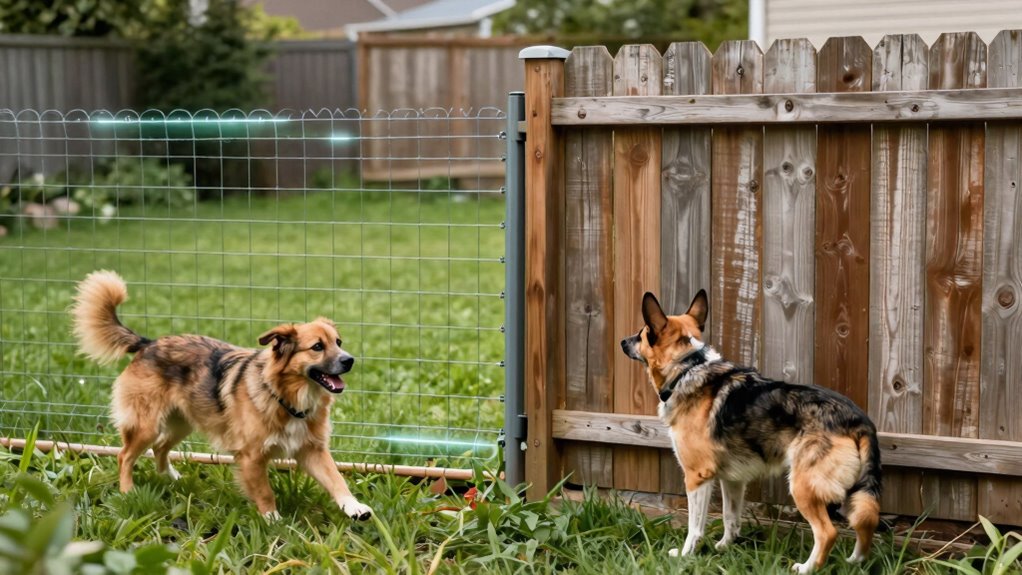

A physical fence is more likely to cause fewer behavioral changes because it provides a clear, visible boundary your dog can see and understand. Wireless fences rely on signals and require consistent training, which can lead to confusion and testing limits. This may cause your dog to behave differently as they try to figure out their boundaries. To learn more about how each option influences your dog’s behavior and what suits your situation best, keep exploring.

Get pet supplies delivered free with Prime
- Fast, free delivery on millions of items
- Prime Video, Amazon Music and more included
- Member-only deals all year
Key Takeaways
- Physical fences provide clear, visible boundaries, reducing confusion and promoting consistent dog behavior.
- Wireless fences rely on signals and training, which may lead to testing limits and behavioral variability.
- Physical fences minimize external distractions, helping dogs focus and behave predictably.
- Wireless fences depend heavily on proper training; inconsistent training can cause behavioral issues.
- Physical fences are a long-term solution, often resulting in more stable and less changed dog behavior.

Wireless fences work by creating a boundary that your dog learns to associate with a correction or warning tone. As your dog approaches the boundary, they hear a beep or feel a mild correction, prompting them to stay within the designated area. This setup can be effective if you invest in consistent, positive training techniques to reinforce boundaries. However, because the boundary is invisible, your dog might become confused if they see openings, such as gates or neighbor’s yards, and may test their limits. The training process with wireless fences often involves a period of gradual acclimation, during which you teach your dog the meaning of the signals. The ease of installation is a major advantage—no digging or building is needed, and costs are generally lower than physical fences. Fence installation costs for wireless systems are usually minimal, often just the price of the device and some training time.
Wireless fences create invisible boundaries that require consistent training to prevent confusion and testing limits.
Physical fences provide a tangible barrier that your dog can see and physically interact with, which can be more effective for reinforcing boundaries. Training techniques here involve consistent reinforcement, rewarding your dog for staying within the yard, and establishing a routine that emphasizes the fence as a boundary they shouldn’t cross. Although the initial costs of installing a physical fence are higher—materials, labor, and time investment—they tend to create a more reliable boundary that doesn’t require ongoing correction or signals. This stability can lead to fewer behavioral issues, such as testing limits or escaping, because your dog perceives a clear, unambiguous barrier. Additionally, physical fences may help reduce behavioral confusion by providing a clear and consistent visual cue for your dog. Installing a physical fence can also serve as a long-term solution that minimizes the need for ongoing training and correction. Furthermore, physical fences can help prevent external distractions, making it easier for your dog to focus on boundaries.
Ultimately, the choice depends on your budget, your dog’s personality, and your willingness to invest time into training. Wireless fences might change your dog’s behavior less in terms of physical boundaries, but they require diligent training and consistent reinforcement. Physical fences, while more costly initially, often promote more natural and consistent behavior because they provide a clear, visible boundary. Both options can be effective, but understanding how they influence your dog’s behavior helps you choose the best solution for your situation.
As an affiliate, we earn on qualifying purchases.
Frequently Asked Questions
How Does Each Fence Type Affect a Dog’s Sense of Territory?
A wireless fence tends to affect your dog’s sense of territory less because it relies on invisible boundaries, so your dog might not perceive a clear physical boundary. This can influence their boundary awareness, making them less confident about their limits. In contrast, a physical fence provides a tangible barrier, reinforcing a stronger sense of territory. Your dog recognizes the physical boundary, which can enhance their boundary awareness and sense of security within their territory.
Are Wireless Fences Safer Than Physical Fences for Dogs?
Wireless fences are generally safer for urban environments because they limit physical barriers, reducing risks of injury or entrapment. They also tend to cause less noise disturbance, which benefits noise-sensitive dogs. However, you should monitor your dog closely since wireless systems rely on signals, and some dogs might test boundaries or become confused. Overall, wireless fences can be safer if properly set up and used with training, especially in noisy or crowded urban settings.
Do Fences Impact a Dog’s Social Interactions With Other Animals?
Fences can influence your dog’s social interactions, affecting dog socialization and causing fence intimidation. A physical fence may limit your dog’s chances to meet new animals, while a wireless fence might reduce boundary awareness, encouraging more outdoor play. Both fences impact social behavior differently—either by restricting opportunities or creating barriers. You’re responsible for balancing safety with social needs, ensuring your dog interacts positively without feeling confined or threatened by the fence.
How Do Fences Influence a Dog’s Training and Obedience?
Fences influence your dog’s training and obedience by providing clear boundaries, which helps with training consistency. A physical fence offers a visual barrier, making it easier for your dog to understand limits, while a wireless fence relies on signals, which can sometimes cause confusion. Additionally, noise sensitivity may be triggered by alarms or beeps from wireless systems, affecting your dog’s focus. Overall, fences shape your dog’s behavior by reinforcing rules and reducing distractions.
What Are the Long-Term Behavioral Effects of Each Fence Type?
Think of each fence as a mirror reflecting your boundary enforcement and communication style. Wireless fences often encourage internal restraint, fostering independence but possibly reducing obedience over time. Physical fences promote clear owner-dog communication, reinforcing obedience and safety. Long-term, wireless fences may lead to more boundary testing, while physical fences strengthen consistent guidance. You shape your dog’s behavior by how you enforce boundaries and communicate, whether through invisible signals or physical barriers.
Conclusion
Choosing between a wireless and physical fence is like picking between a gentle nudge or a firm handshake—it depends on your dog’s personality. I once watched a shy pup hesitate at a physical fence, feeling boxed in, while a curious border collie enthusiastically tested a wireless boundary, exploring confidently. Studies show wireless fences can reduce territorial aggression, but they might not suit every dog. Think about your pup’s comfort—sometimes, a fence is just a friendly guide, not a barrier.
Fall Picks
fall essentials
As an affiliate, we earn on qualifying purchases.