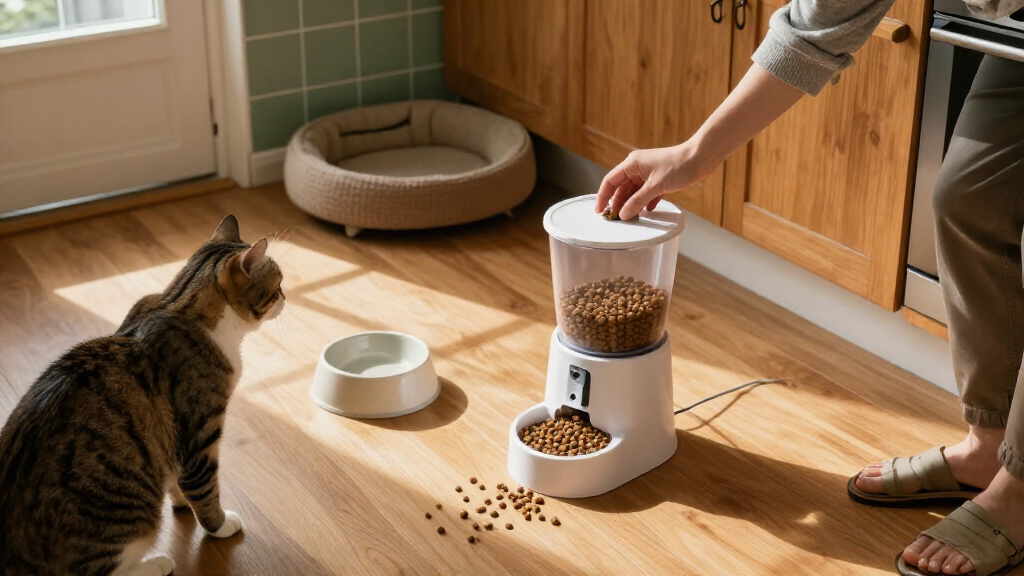

For most homes, I’d start with the PETLIBRO 5L Wi-Fi Automatic Pet Feeder, which balances app scheduling, useful capacity, and a stainless steel bowl. The Inetzora 2K Camera Feeder stands out for owners who want video check-ins, while the PETLIBRO RFID Feeder is a more specialized choice for tracking an individual cat’s meals. The main tradeoffs are storage capacity versus counter space, simple timed feeding versus app features, and whether a camera or pet-specific access control is worth the added complexity. No automatic feeder replaces fresh water, regular checks, or care during an extended absence. Read on for the full comparison, buying advice, and picks for different households.

Get pet supplies delivered free with Prime
- Fast, free delivery on millions of items
- Prime Video, Amazon Music and more included
- Member-only deals all year
Complete the kit


Key Takeaways
- The PETLIBRO 5L Wi-Fi model is the most balanced starting point in this lineup, pairing app scheduling with a stainless steel bowl without adding a camera as a core requirement.
- Camera models solve a different problem from ordinary feeders: Inetzora, Frienhund, and PETLIBRO’s 1080p option add remote visual check-ins, but buyers should weigh that against extra setup and connectivity needs.
- Capacity varies widely, from compact 3L options to an 8L dispenser. Larger storage can reduce refills, but it takes more room and does not mean food stays fresh indefinitely.
- Multi-pet households need more than a larger hopper. The HoneyGuaridan and oneisall 5L models provide two-bowl setups, while PETLIBRO RFID targets more individualized access and diet tracking.
- Basic timed feeders remain relevant for buyers who want fewer app dependencies. Voluas and the LCD-equipped 8L model put scheduled dispensing ahead of camera or connected features.
| PETLIBRO 5L Wi-Fi Automatic Pet Feeder with Stainless Steel Bowl |  | Best Overall | Capacity: 5 liters | Meals per day: Up to 10 | Portions per meal: 1–48 portions; 1/12 cup per portion | VIEW LATEST PRICE | See Our Full Breakdown |
| PAPIFEED WiFi Automatic Cat Feeder, 6L, White |  | Best for Easy Cleanup | Capacity: 6 liters (25 cups) | Meals per day: 1–10 | Portions per meal: Up to 12 | VIEW LATEST PRICE | See Our Full Breakdown |
| oneisall 2.4 GHz Wi-Fi Automatic Cat Feeder, 3.5 L, 15 Cups |  | Best for Shared App Access | Capacity: 15 cups (4 lb) | Meals per day: 1–10 | Portions per meal: 1–36; approximately 7 g per portion | VIEW LATEST PRICE | See Our Full Breakdown |
| IMIPAW Automatic Cat Feeder, 3 L, White |  | Best Simple Programmable Feeder | Capacity: 3 L (12 cups) | Meals per day: Up to 6 | Portion size: About 7–9 g per serving | VIEW LATEST PRICE | See Our Full Breakdown |
| PETKIT Wi-Fi Automatic Pet Feeder with App Control, 3L Capacity |  | Best for Small-Kibble Flexibility | Capacity: 3 L (approximately 12 cups; about 1.33 kg / 2.9 lb of food) | Meals per day: Up to 10 | Portions per meal: 1–5; 1/10 cup per portion | VIEW LATEST PRICE | See Our Full Breakdown |
| HoneyGuaridan Wi-Fi Automatic Cat Feeder for Two Cats with Stainless Steel Bowls |  | Best for Scheduled Feeding in Two-Bowl Homes | Capacity: 3.5 liters | Feeding schedule: Up to 6 meals per day | Portion size: Approximately 6 g per portion | VIEW LATEST PRICE | See Our Full Breakdown |
| Inetzora Automatic Pet Feeder with 2K Camera, 6L Capacity, and Dual-Band Wi-Fi |  | Best for Camera Check-Ins and Remote Interaction | Capacity: 6 L (24 cups) | Camera: 2K HD, 3 MP | Night vision: Infrared | VIEW LATEST PRICE | See Our Full Breakdown |
| Automatic Pet Feeder with 8L Capacity, LCD Screen, and Stainless Steel Bowl |  | Best for High-Capacity, App-Free Feeding | Capacity: 8 L (34 cups) | Feeding schedule: Up to 6 meals per day | Portion size: 1–50 portions per meal; approximately 1/16 cup per portion | VIEW LATEST PRICE | See Our Full Breakdown |
| ANDOLL HOME Automatic Cat and Dog Feeder, 4L |  | Best for Straightforward, Frequent Meal Scheduling | Capacity: 4 liters | Meals per day: Up to 8 | Voice recording: 10 seconds | VIEW LATEST PRICE | See Our Full Breakdown |
| PETLIBRO RFID Automatic Cat Feeder with Wi-Fi and Diet Tracking |  | Best for Keeping One Cat’s Food Separate | Capacity: 3 liters | Food type: Dry food | Connectivity: Dual-band Wi-Fi (2.4 GHz and 5 GHz) and Bluetooth | VIEW LATEST PRICE | See Our Full Breakdown |
| oneisall 5L Wi-Fi Automatic Cat Feeder for Two Cats |  | Best for Two Cats | Capacity: 5 liters (20 cups) | Portion size: Approximately 10 g (1/12 cup) per portion | Kibble size: Less than 0.5 inch | VIEW LATEST PRICE | See Our Full Breakdown |
| Voluas Automatic Pet Feeder, 4L Timed Dry Food Dispenser |  | Best for Simple, Screen-Based Setup | Capacity: 4 liters (16.9 cups) | Meal schedule: 1–4 meals per day | Portion settings: 0–40 portions | VIEW LATEST PRICE | See Our Full Breakdown |
| Frienhund Automatic Pet Feeder with 2K Camera, Night Vision, and 7L Food Storage |  | Best for Camera Monitoring and High Capacity | Capacity: 7L (29 cups) | Camera: 3-megapixel Full HD with infrared night vision | Wi-Fi: 2.4 GHz and 5 GHz | VIEW LATEST PRICE | See Our Full Breakdown |
| PETLIBRO Automatic Cat Feeder with 1080p Camera and Night Vision |  | Best Camera Feeder for Cats | Model: PLAF203 | Capacity: 5 liters | Camera: 1080p HD with night vision | VIEW LATEST PRICE | See Our Full Breakdown |
| automatic pet feeder | Capacity | Power | Dimensions | Connectivity |
|---|---|---|---|---|
| PETLIBRO 5L Wi-Fi Automatic Pe | 5 liters | Corded electric | 7.95 × 7.72 × 11.54 inches | 2.4 GHz and 5 GHz Wi-Fi; Bluetooth |
| PAPIFEED WiFi Automatic Cat Fe | 6 liters (25 cups) | 5V DC adapter or 4 AA batteries (not included) | 7.56 × 11.93 × 13.3 inches | Wi-Fi with app control |
| oneisall 2.4 GHz Wi-Fi Automat | 15 cups (4 lb) | Corded electric; backup support for 4 Type-A batteries (not included) | 6.63 × 6.63 × 11.38 inches | 2.4 GHz Wi-Fi |
| IMIPAW Automatic Cat Feeder | 3 L (12 cups) | 5V DC adapter or 3 D-cell batteries (not included) | 7 × 12 × 7 inches | — |
| PETKIT Wi-Fi Automatic Pet Fee | 3 L (approximately 12 cups; about 1.33 kg / 2.9 lb of food) | USB cable and batteries | — | 2.4 GHz Wi-Fi |
| HoneyGuaridan Wi-Fi Automatic | 3.5 liters | USB-C adapter or 3 D-cell batteries (not included) | 7.6 × 7.1 × 11.8 inches | — |
| Inetzora Automatic Pet Feeder | 6 L (24 cups) | 5V DC adapter; backup for 3 D-cell batteries (not included) | — | — |
| Automatic Pet Feeder with 8L C | 8 L (34 cups) | Type-C adapter or 4 AA batteries (not included) | — | — |
| ANDOLL HOME Automatic Cat and | 4 liters | 5V DC adapter; backup with 3 AA batteries (not included) | 12 × 7 × 13 inches | — |
| PETLIBRO RFID Automatic Cat Fe | 3 liters | Corded electric with battery backup | 10.43 × 9.45 × 17.13 inches | Dual-band Wi-Fi (2.4 GHz and 5 GHz) and Bluetooth |
| oneisall 5L Wi-Fi Automatic Ca | 5 liters (20 cups) | — | 16.73 × 7.09 × 13.4 inches | 2.4 GHz and 5 GHz Wi-Fi |
| Voluas Automatic Pet Feeder | 4 liters (16.9 cups) | 5V USB adapter or three D-cell batteries (not included) | — | — |
| Frienhund Automatic Pet Feeder | 7L (29 cups) | 5V DC adapter or three D-cell batteries | — | — |
| PETLIBRO Automatic Cat Feeder | 5 liters | — | 13.78 × 12.99 × 7.48 inches | 2.4 GHz and 5 GHz Wi-Fi |
More Details on Our Top Picks
PETLIBRO 5L Wi-Fi Automatic Pet Feeder with Stainless Steel Bowl
I’d put the PETLIBRO 5L at the top for buyers who want flexible app scheduling without stepping up to a camera-equipped feeder. It supports up to 10 meals a day, adjustable portions, feeding records, and remote control over Wi-Fi, making it more useful for fine-tuning a routine than the basic, non-app IMIPAW 3L. Its twist-lock lid, sealing strip, and desiccant help limit moisture exposure, while the stainless steel bowl and blockage alerts add practical touches for daily use.
The tradeoff is that this model is for dry kibble only, within a specified 2–15 mm size range, and the base cannot be washed. The desiccant also needs frequent replacement. I’d choose the PAPIFEED instead if dishwasher-safe removable food-contact parts and a larger hopper matter more than this feeder’s portion range and alerts.
Pros:- Schedules up to 10 meals daily with 1–48 adjustable portions per meal.
- App supports remote scheduling and feeding records.
- Sealed lid and desiccant bag help protect kibble from moisture.
- Stainless steel bowl and infrared sensor provide useful everyday features.
Cons:- The feeder base should not be washed.
- The desiccant bag needs replacement about every half month.
- Only works with dry kibble between 2 and 15 mm in diameter.
Best for: Cat owners who want detailed app scheduling, feeding records, and a stainless steel bowl for dry kibble.
Not ideal for: Owners feeding wet food or oversized kibble, or anyone who wants a feeder whose base can be washed.
- Capacity:5 liters
- Meals per day:Up to 10
- Portions per meal:1–48 portions; 1/12 cup per portion
- Connectivity:2.4 GHz and 5 GHz Wi-Fi; Bluetooth
- Food compatibility:Dry kibble, 2–15 mm diameter
- Bowl material:Stainless steel
- Dimensions:7.95 × 7.72 × 11.54 inches
- Power:Corded electric
Our verdict“Choose the PETLIBRO 5L if you want flexible app-based feeding and alerts for a dry-kibble routine, and can keep its base clean without washing it.”
PAPIFEED WiFi Automatic Cat Feeder, 6L, White
The PAPIFEED 6L is the lineup’s cleanup-focused choice: its removable hopper and stainless steel bowl are dishwasher safe, so routine washing is less of a chore than with the PETLIBRO 5L, whose base must stay out of the sink. It also has the largest hopper among these five, with app scheduling for up to 10 meals a day. That extra capacity can mean fewer refills for households that want a straightforward dry-food routine.
Its portion control is less flexible than PETLIBRO’s: PAPIFEED allows up to 12 portions per meal, compared with the PETLIBRO’s 48. The feeder also needs four AA batteries, not included, for backup during an outage. I’d favor the oneisall 3.5L for a smaller footprint and shared app access, but the PAPIFEED makes more sense when capacity and washable parts lead the decision.
Pros:- 6-liter hopper holds more food than the other four feeders in this batch.
- Removable hopper and stainless steel bowl are dishwasher safe.
- App schedules up to 10 meals per day.
- Four AA batteries can provide backup power during an outage.
Cons:- Backup AA batteries are not included.
- Allows up to 12 portions per meal, fewer than the PETLIBRO 5L.
- Designed for dry food only.
Best for: Households that feed dry food, want a larger hopper, and value dishwasher-safe removable parts.
Not ideal for: Owners who need fine-grained portion settings or want backup batteries included.
- Capacity:6 liters (25 cups)
- Meals per day:1–10
- Portions per meal:Up to 12
- Connectivity:Wi-Fi with app control
- Food type:Dry food
- Power:5V DC adapter or 4 AA batteries (not included)
- Care:Removable parts are dishwasher safe
- Dimensions:7.56 × 11.93 × 13.3 inches
Our verdict“Pick the PAPIFEED if washable parts and a larger dry-food hopper matter more to you than broader portion adjustment.”
oneisall 2.4 GHz Wi-Fi Automatic Cat Feeder, 3.5 L, 15 Cups
The oneisall 3.5L suits homes where more than one person needs to manage the feeding routine: its app access can be shared with family members, alongside scheduling for up to 10 meals daily. Its 1–36 portions per meal give it a wider adjustment range than the PAPIFEED 6L, though the PAPIFEED holds more food and has dishwasher-safe hopper parts. The oneisall is also relatively compact at 6.63 inches wide, a helpful fit when counter or floor space is limited.
There’s a meaningful catch to its backup power: preset feeding continues on batteries, but Wi-Fi, app features, and feeding logs are unavailable in that mode. It also requires 2.4 GHz Wi-Fi and the batteries are not included. I’d choose the PETLIBRO 5L for its larger capacity and broader Wi-Fi bands; this model makes more sense when a smaller footprint and shared household control are priorities.
Pros:- App access can be shared with family members.
- Schedules 1–10 meals daily with up to 36 portions per meal.
- Compact 6.63-inch width suits tighter spaces.
- Dishwasher-safe stainless steel bowl and two-year warranty.
Cons:- App, Wi-Fi, and feeding logs are unavailable on battery power.
- Requires 2.4 GHz Wi-Fi for app control.
- Backup batteries are not included.
Best for: Cat households where multiple caregivers need app access and a compact feeder for dry food.
Not ideal for: Owners who expect app control or feeding logs to work during battery backup, or who need a large hopper.
- Capacity:15 cups (4 lb)
- Meals per day:1–10
- Portions per meal:1–36; approximately 7 g per portion
- Connectivity:2.4 GHz Wi-Fi
- Power:Corded electric; backup support for 4 Type-A batteries (not included)
- Bowl care:Dishwasher safe
- Dimensions:6.63 × 6.63 × 11.38 inches
- Warranty:2 years
Our verdict“Choose the oneisall 3.5L for a compact feeder with shared app access, provided you can accept limited controls during a power outage.”
IMIPAW Automatic Cat Feeder, 3 L, White
If app access is not part of your checklist, the IMIPAW 3L keeps feeding straightforward: set its 12-hour clock, program up to six daily meals, and adjust portions of about 7–9 g. That simpler setup distinguishes it from the PETLIBRO 5L and PETKIT P570, both of which add Wi-Fi app control and more daily scheduling. The IMIPAW instead offers dual power options and a removable tray, giving buyers a basic routine without app dependence.
Capacity is modest at 3 liters, and the feeder is intended for dry food, so it is less suited to households seeking a large hopper or remote schedule changes. Its tray is hand-wash only, and the three D-cell backup batteries are not included. Compared with the oneisall 3.5L, it holds less and lacks app sharing, but it may appeal to owners who prefer local programming over connected features.
Pros:- Programs up to six meals per day with adjustable portions.
- Runs on a DC adapter or three D-cell batteries.
- Removable tray makes routine cleaning easier.
- Lockable lid and desiccant bag help protect stored food.
Cons:- No Wi-Fi or app control for remote changes.
- Hand-wash-only care takes more effort than dishwasher-safe alternatives.
- Three D-cell backup batteries are not included.
Best for: Cat and small-pet owners who want a simple, locally programmed dry-food schedule with battery backup.
Not ideal for: Owners who need app control, more than six daily meals, or dishwasher-safe cleanup.
- Capacity:3 L (12 cups)
- Meals per day:Up to 6
- Portion size:About 7–9 g per serving
- Daily portions:Up to 20
- Food type:Dry food
- Power:5V DC adapter or 3 D-cell batteries (not included)
- Dimensions:7 × 12 × 7 inches
- Care:Hand wash only
Our verdict“Pick the IMIPAW if you want a no-app programmable feeder for a small pet and do not need more than six meals a day.”
PETKIT Wi-Fi Automatic Pet Feeder with App Control, 3L Capacity
The PETKIT P570 is a compact app-controlled option for owners whose pets eat dry, air-dried, or freeze-dried food. It schedules up to 10 meals and supports manual dispensing in the app, while its pet-proof lid and sealed container help keep curious paws and moisture away from stored food. Compared with the IMIPAW 3L, it adds remote control and feeding records; compared with the PETLIBRO 5L, it takes less space but offers a smaller capacity and a narrower portion range.
That portion limit—one to five portions per meal, at 1/10 cup each—makes this a weaker fit for pets needing finely adjusted servings. It also requires 2.4 GHz Wi-Fi for app features and only accepts kibble under 12 mm. USB and battery power add flexibility, but the one-year warranty is shorter than the two-year coverage listed for the oneisall.
Pros:- App supports scheduling, manual feeding, and feeding records.
- Sealed container and pet-proof lid help protect stored food.
- Stainless steel bowl is made from 304 stainless steel.
- Can run on USB power or batteries.
Cons:- Limited to 1–5 portions per meal.
- Requires 2.4 GHz Wi-Fi for app connectivity.
- Kibble must be under 12 mm in size.
Best for: Owners of pets eating small dry, air-dried, or freeze-dried food who want app scheduling in a compact feeder.
Not ideal for: Pets needing large or precisely adjusted servings, or owners whose kibble is 12 mm or larger.
- Capacity:3 L (approximately 12 cups; about 1.33 kg / 2.9 lb of food)
- Meals per day:Up to 10
- Portions per meal:1–5; 1/10 cup per portion
- Connectivity:2.4 GHz Wi-Fi
- Food compatibility:Dry, air-dried, and freeze-dried food; kibble under 12 mm
- Bowl material:304 stainless steel
- Power:USB cable and batteries
- Warranty:1 year
Our verdict“Choose the PETKIT P570 for app-controlled feeding with small kibble or freeze-dried food, but skip it if your pet needs larger portions.”
HoneyGuaridan Wi-Fi Automatic Cat Feeder for Two Cats with Stainless Steel Bowls
I’d choose the HoneyGuaridan S303D when two cats need portions dispensed at the same time without relying on a single shared bowl. Its dual chute directs dry food to two bowls, and the app supports remote scheduling, feeding records, and up to six meals a day. Dual-band Wi-Fi offers more connection flexibility than a feeder limited to one band, while the sealed storage and desiccant bag help protect kibble between meals. Compared with the ANDOLL HOME 4L, this model is built around feeding two cats rather than adding a tilted bowl and more daily meal slots. The tradeoff is a relatively modest 3.5-liter capacity, and portion weight can vary with kibble size. Wi-Fi also stops when it runs on batteries alone.
Pros:- Dual chute dispenses food to two bowls.
- App provides remote scheduling, controls, and feeding records.
- Sealed storage and a desiccant bag help limit moisture exposure.
- Battery backup can keep scheduled feeding running during a power outage.
Cons:- The 3.5-liter capacity may need frequent refills in a multi-cat home.
- Wi-Fi features require the feeder to be plugged in.
- Three D-cell backup batteries are not included, and portion weight varies by kibble.
Best for: Households with two cats eating the same dry food who want app scheduling and separate bowls.
Not ideal for: Homes needing large food storage, wet-food dispensing, or app control during a power outage when the feeder is running on batteries.
- Capacity:3.5 liters
- Feeding schedule:Up to 6 meals per day
- Portion size:Approximately 6 g per portion
- Wi-Fi:2.4 GHz and 5 GHz
- Power:USB-C adapter or 3 D-cell batteries (not included)
- Voice message:Up to 10 seconds
- Dimensions:7.6 × 7.1 × 11.8 inches
Our verdict“Choose the HoneyGuaridan if two cats need separate bowls and app-scheduled dry meals, but skip it if high capacity or battery-powered Wi-Fi matters most.”
Inetzora Automatic Pet Feeder with 2K Camera, 6L Capacity, and Dual-Band Wi-Fi
The Inetzora pairs meal scheduling with a 2K camera, infrared night vision, and two-way audio, making it a stronger fit for owners who want to check in as well as dispense food. Its 6-liter hopper holds more than the HoneyGuaridan S303D, and its schedule allows up to ten meals a day with adjustable portions. That extra flexibility can help owners split a daily ration into smaller feedings. A removable BPA-free tank and dishwasher-safe stainless steel bowl also make routine cleaning easier than the hand-wash bowl on the ANDOLL HOME 4L. The feature set comes with a catch: cloud storage and AI Sentinel features may require subscriptions after the stated trial period. Backup D-cell batteries are also not included, and the camera adds complexity for buyers who only need timed meals.
Pros:- 2K camera with infrared night vision supports remote check-ins in low light.
- Two-way audio allows communication through the app.
- Schedules up to 10 meals a day with 1–15 portions per meal.
- Removable BPA-free tank and dishwasher-safe stainless steel bowl simplify cleaning.
Cons:- Cloud storage and AI Sentinel features may require a subscription after the stated free trial.
- Three D-cell backup batteries are not included.
- Camera and app features add complexity compared with basic timed feeders such as the ANDOLL HOME 4L.
Best for: Cat owners who want to monitor and speak to a pet remotely while scheduling frequent dry-food meals.
Not ideal for: Buyers who want a simple feeder without app-connected camera features or possible ongoing costs for cloud and AI services.
- Capacity:6 L (24 cups)
- Camera:2K HD, 3 MP
- Night vision:Infrared
- Audio:Two-way audio and pet voice interaction
- Wi-Fi:2.4 GHz and 5 GHz
- Feeding schedule:Up to 10 meals per day, 1–15 portions per meal
- Bowl:304 stainless steel; dishwasher-safe
- Power:5V DC adapter; backup for 3 D-cell batteries (not included)
Our verdict“Pick the Inetzora if remote camera access and frequent app-scheduled meals matter more than keeping the feeder simple.”
Automatic Pet Feeder with 8L Capacity, LCD Screen, and Stainless Steel Bowl
For a household that would rather refill less often than manage meals through an app, this feeder’s main advantage is its 8-liter hopper and straightforward LCD controls. It schedules up to six meals daily, with portions adjustable from one to 50 servings, so owners can tune the amount without needing Wi-Fi. That capacity exceeds the Inetzora’s 6-liter hopper, though the Inetzora offers camera monitoring and a larger number of scheduled meals. A stainless steel bowl, removable parts, locking lid, and anti-jamming design address everyday feeding and cleanup needs. The limits are practical: it handles dry kibble only, kibble must be no larger than 18 mm, and four AA backup batteries are not included. Portion sizes are described in servings, so owners should account for kibble differences when setting a ration.
Pros:- Large 8-liter capacity reduces refill frequency compared with the 6-liter Inetzora.
- LCD controls schedule up to six meals with 1–50 portions per meal.
- Stainless steel bowl and removable components support easier cleaning.
- Locking lid, desiccant bag, and anti-jamming design address food storage and dispensing.
Cons:- Does not offer Wi-Fi or remote app control.
- Limited to dry kibble up to 18 mm.
- Four AA backup batteries are not included.
Best for: Owners of cats or dogs who eat dry kibble and want substantial storage, adjustable portions, and simple on-device scheduling.
Not ideal for: People who need app-based remote control, camera monitoring, wet-food feeding, or a feeder that accepts large kibble.
- Capacity:8 L (34 cups)
- Feeding schedule:Up to 6 meals per day
- Portion size:1–50 portions per meal; approximately 1/16 cup per portion
- Bowl:6.7-inch diameter, stainless steel
- Kibble limit:Up to 18 mm
- Power:Type-C adapter or 4 AA batteries (not included)
- Display:LCD screen
- Additional features:Locking lid, desiccant bag, anti-jamming mechanism, voice recording and playback, manual feeding
Our verdict“Choose this feeder for large dry-food storage and on-device scheduling, not for remote monitoring or app control.”
ANDOLL HOME Automatic Cat and Dog Feeder, 4L
The ANDOLL HOME FT-3S suits owners who want scheduled dry-food portions without the camera and subscription considerations of the Inetzora. It supports up to eight meals daily, more than the six-meal schedules on the HoneyGuaridan S303D and the 8L LCD feeder. A short voice recording can call a pet when food is dispensed, while the sealed lid and desiccant compartment help protect stored kibble. Its swinging dispenser is designed to reduce blockages, and the 8-degree bowl tilt changes the eating angle rather than adding app features. At four liters, storage is more modest than the 8L feeder, and there is no stated Wi-Fi control. The stainless steel bowl needs hand washing, so it is less convenient to clean than the Inetzora’s dishwasher-safe bowl.
Pros:- Schedules up to eight meals daily with portion control.
- Ten-second voice recording can call pets at feeding time.
- Sealed lid and desiccant compartment help protect dry food from moisture.
- Swinging dispenser is designed to reduce blockages, and the bowl tilts 8 degrees.
Cons:- Four-liter capacity is smaller than the 8L LCD feeder.
- No Wi-Fi or remote app control is specified.
- Stainless steel bowl is hand-wash only, and backup AA batteries are not included.
Best for: Owners who want a no-frills dry-food feeder with up to eight scheduled meals and a recorded mealtime call.
Not ideal for: Buyers who need remote app control, a large food reservoir, or a dishwasher-safe bowl.
- Capacity:4 liters
- Meals per day:Up to 8
- Voice recording:10 seconds
- Bowl tilt:8 degrees
- Power:5V DC adapter; backup with 3 AA batteries (not included)
- Dimensions:12 × 7 × 13 inches
- Material:Stainless steel
- Food type:Dry food
Our verdict“Choose the ANDOLL HOME for frequent scheduled meals and a simple voice call, but look elsewhere for app control or easier bowl cleanup.”
PETLIBRO RFID Automatic Cat Feeder with Wi-Fi and Diet Tracking
The PETLIBRO RFID feeder tackles a problem that extra capacity or more meal slots cannot solve: another cat stealing the designated cat’s food. Its included collar tag controls access, while the app supports portion scheduling and eating-habit tracking. That makes it more targeted than the HoneyGuaridan S303D, which sends food to two bowls but does not identify which cat eats from them. Dual-band Wi-Fi, Bluetooth, and battery backup support connected feeding, including during power or internet outages according to the product description. The tradeoff is a 3-liter capacity, smaller than the HoneyGuaridan and far below the 8L LCD feeder. Access control also depends on the supplied RFID collar tag; it is not microchip activated. This is a dry-food system, and the feeder base and RFID reader should not be washed with water.
Pros:- RFID collar-tag access helps keep other cats from taking the designated cat’s food.
- App supports meal scheduling, portion control, and eating-habit tracking.
- Battery backup supports continued feeding during power outages.
- Removable stainless steel bowl and shields support a separate feeding setup.
Cons:- Access control uses the included RFID collar tag and does not activate from a microchip.
- Three-liter capacity is smaller than the HoneyGuaridan S303D and the 8L LCD feeder.
- Designed for dry food, and the feeder base and RFID reader should not be washed with water.
Best for: Multi-cat households where one cat needs controlled access to a separate dry-food ration and owners want eating data.
Not ideal for: Homes where a cat will not wear the included collar tag, buyers seeking microchip activation, or owners needing a large-capacity or wet-food feeder.
- Capacity:3 liters
- Food type:Dry food
- Connectivity:Dual-band Wi-Fi (2.4 GHz and 5 GHz) and Bluetooth
- Access control:Included RFID collar tag; not microchip activated
- Power:Corded electric with battery backup
- Dimensions:10.43 × 9.45 × 17.13 inches
- Weight:7.7 lb
- Model:PLAF301
Our verdict“Choose the PETLIBRO if one cat needs protected access to a tracked dry-food ration; skip it if collar tags or limited storage are a poor fit.”
oneisall 5L Wi-Fi Automatic Cat Feeder for Two Cats
The oneisall 5L is the clearest fit here for households that want one scheduled feeder to serve two cats: it sends the same measured portion to two stainless steel bowls, while app controls let an owner schedule meals, dispense food remotely, and check feeding logs. Its 5-liter hopper holds more than the Voluas 4L, and unlike that simpler timed feeder, this one adds Wi-Fi access and family app sharing. A short recorded call can signal mealtime, though it is limited to 10 seconds. The tradeoff is a narrower food fit: kibble must be smaller than 0.5 inch, and the main unit cannot be washed with water. I’d choose it over a camera-equipped model when shared feeding matters more than watching meals remotely.
Pros:- Dispenses the same measured amount to two separate stainless steel bowls.
- App supports scheduled and manual feeding, feeding logs, and family sharing.
- 5-liter capacity reduces how often the hopper needs refilling.
- 10-second voice recording can call cats at mealtime.
Cons:- Kibble must be smaller than 0.5 inch, limiting food compatibility.
- The main unit is not water-washable.
- Both bowls receive the same amount, so it does not suit cats on different portions.
Best for: Households with two cats that eat the same dry food and need scheduled portions delivered to separate bowls.
Not ideal for: Owners using larger kibble or anyone who wants a camera to check whether each cat reaches its bowl.
- Capacity:5 liters (20 cups)
- Portion size:Approximately 10 g (1/12 cup) per portion
- Kibble size:Less than 0.5 inch
- Connectivity:2.4 GHz and 5 GHz Wi-Fi
- Bowl material:Stainless steel; two bowls included
- Voice recording:10 seconds
- Dimensions:16.73 × 7.09 × 13.4 inches
- Warranty:2 years
Our verdict“Choose the oneisall if two cats need matching scheduled portions from one Wi-Fi feeder; skip it if their diets differ or you need a camera.”
Voluas Automatic Pet Feeder, 4L Timed Dry Food Dispenser
The Voluas 4L suits owners who want scheduled dry-food portions without relying on an app. Its LCD screen handles plans of one to four meals a day, and removable parts make routine cleaning more straightforward than on the oneisall 5L, whose main unit is not water-washable. The portion setting reaches 40 increments, with each portion around 6–7 g, giving owners a finer small-step option than the oneisall’s approximately 10 g increments. It also accepts USB power or three D-cell batteries, so battery backup is available if the power goes out, but the batteries are not included. This is a simpler choice than the camera-equipped PETLIBRO, but it gives up Wi-Fi control and remote meal checks. It is for dry food only.
Pros:- LCD controls schedule one to four daily meals and adjustable portions.
- USB power and optional D-cell batteries offer a backup power route.
- Removable parts make cleaning easier.
- 10-second voice recording can call a pet at mealtime.
Cons:- Three D-cell batteries are not included.
- Dry food only; it cannot dispense wet food.
- No Wi-Fi app control or camera for remote checks.
Best for: Owners who prefer programming meals on a built-in screen and want a battery option without app setup.
Not ideal for: People who need remote feeding controls, camera monitoring, or a feeder for wet food.
- Capacity:4 liters (16.9 cups)
- Meal schedule:1–4 meals per day
- Portion settings:0–40 portions
- Portion size:Approximately 6–7 g per portion
- Power:5V USB adapter or three D-cell batteries (not included)
- Food type:Dry food
- Voice recording:Up to 10 seconds
- Warranty:1 year
Our verdict“Pick the Voluas for straightforward screen-based scheduling and flexible power, but choose a connected model if you need remote oversight.”
Frienhund Automatic Pet Feeder with 2K Camera, Night Vision, and 7L Food Storage
For owners who want to see meals as well as schedule them, the Frienhund 7L combines a camera, motion alerts, and two-way audio with the largest stated hopper in this group. Its 7L transparent tank holds about 29 cups, giving it a capacity advantage over the 5L PETLIBRO camera feeder and the 5L oneisall. The app supports up to 15 meals per day and 20 portions per meal, so it offers more frequent scheduling than PETLIBRO’s limit of 10 meals. Infrared night vision helps with low-light checks, while detachable parts and a dishwasher-safe stainless steel bowl simplify cleanup. The added monitoring features mean more connected functions to manage, and battery backup requires three D-cell batteries that are not included. TF-card storage tops out at 128GB.
Pros:- 7L tank holds more food than the 5L PETLIBRO and oneisall models.
- Camera offers infrared night vision, motion alerts, and two-way audio.
- Schedules up to 15 meals per day with up to 20 portions per meal.
- Detachable tank and dishwasher-safe stainless steel bowl ease cleanup.
Cons:- Three D-cell backup batteries are not included.
- TF-card storage supports up to 128GB.
- Camera, alerts, and app features may be unnecessary for buyers seeking simple timed feeding.
Best for: Owners of cats or other small pets who want frequent scheduled meals, a large hopper, and remote visual checks.
Not ideal for: Buyers who want a basic feeder without camera or app features, or who need included backup batteries.
- Capacity:7L (29 cups)
- Camera:3-megapixel Full HD with infrared night vision
- Wi-Fi:2.4 GHz and 5 GHz
- Feeding schedule:Up to 15 meals per day; maximum 20 portions per meal
- Audio:Two-way audio
- Storage:TF card up to 128GB and cloud storage
- Power:5V DC adapter or three D-cell batteries
- Cleaning:Detachable food tank; stainless steel bowl is dishwasher-safe
Our verdict“Choose the Frienhund if a large food reserve and camera-based meal checks matter more than keeping the feeder simple.”
PETLIBRO Automatic Cat Feeder with 1080p Camera and Night Vision
The PETLIBRO PLAF203 pairs app-based scheduling with a 1080p camera, night vision, and two-way audio, making it a strong choice for cat owners who want to check in without stepping up to the Frienhund’s larger 7L capacity. It schedules up to 10 meals per day and sends feeding notifications, while its sealed 5-liter tank, desiccant compartment, and anti-blockage design address food freshness and dispensing flow. Compared with the simpler Voluas, it adds remote monitoring and app control; compared with the Frienhund, it offers fewer scheduled meals and less storage, but keeps the feature set focused on cats. The feeder’s motor base must not be immersed in water, so cleaning calls for care. Its personalized meal call is also capped at 10 seconds.
Pros:- 1080p camera with night vision supports remote meal checks.
- App schedules up to 10 meals per day and provides feeding notifications.
- Two-way audio and a personalized meal call support check-ins at feeding time.
- Sealed tank, desiccant compartment, and anti-blockage design support food storage and dispensing.
Cons:- The motor base must not be immersed in water.
- Personalized meal calls are limited to 10 seconds.
- Its 5-liter capacity is smaller than the Frienhund 7L.
Best for: Cat owners who want app scheduling, meal notifications, and a camera for remote check-ins in a 5-liter feeder.
Not ideal for: Households needing a larger food reservoir, schedules beyond 10 meals a day, or a base that can be submerged for cleaning.
- Model:PLAF203
- Capacity:5 liters
- Camera:1080p HD with night vision
- Connectivity:2.4 GHz and 5 GHz Wi-Fi
- Feeding schedule:Up to 10 meals per day
- Audio:Two-way audio and personalized meal call up to 10 seconds
- Dimensions:13.78 × 12.99 × 7.48 inches
- Warranty:24 months
Our verdict“Choose this PETLIBRO for camera-assisted cat feeding in a compact 5-liter setup, but favor the Frienhund for more capacity or more daily meals.”
How We Picked
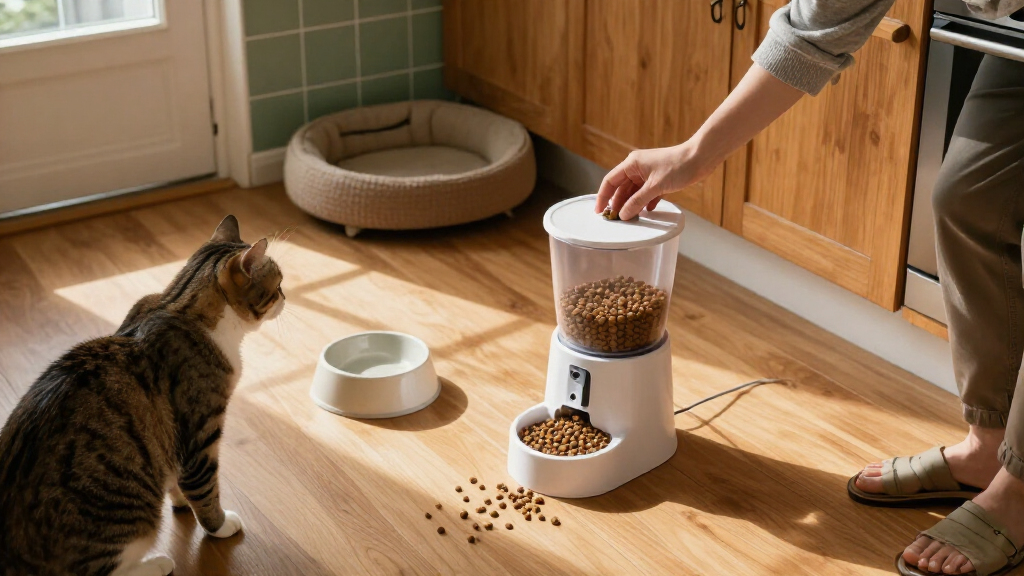
I compared these feeders by how well their designs address everyday feeding needs: dependable scheduled dispensing, useful capacity, portion and meal controls, ease of setup, cleaning, and practical food-bowl design. I also looked at the added value of Wi-Fi, cameras, night vision, RFID access, and two-bowl layouts, while accounting for the extra setup or household limits those features can bring. Since the product list spans compact dispensers, connected models, camera feeders, and multi-cat designs, I judged each against its intended use rather than treating the longest feature list as the winner.
The ranking gives priority to versatility for a typical single-pet household, then recognizes options that do a particular job better, such as supporting two cats or enabling remote visual checks. Capacity alone does not determine placement: a large hopper is useful only if it fits the home and suits the feeding routine. I also weigh simpler operation as a benefit for buyers who do not need app control. Product-specific claims should be checked against the current listing, especially supported food size, backup power, and app functions.
Factors to Consider When Choosing Best Automatic Pet Feeders
I’d choose an automatic feeder by starting with the feeding problem it needs to solve, then checking whether its features fit the home and the pet. These broader questions can prevent common mismatches that a product feature list may not reveal.
Match Capacity to Your Routine and Your Space
A larger hopper can cut down on refills, but it is not automatically the better choice. Estimate how much dry food your pet eats each day and how often you want to refill, then account for the feeder’s footprint and the space needed to remove its container for cleaning. A 3L model may suit a small cat and a compact kitchen, while a 7L or 8L design may fit a busier household or a longer interval between refills. Avoid filling a large hopper so far ahead that food sits for an unnecessarily long period. Capacity figures also do not tell you whether a feeder dispenses the portion sizes your pet needs. Match the dispenser’s meal settings to your feeding plan before deciding that more storage is the answer.
Check Portion Control Against the Actual Food
Automatic feeders commonly dispense dry food by timed portions, but a portion setting is not the same as a measured weight. Kibble shape and size can affect how much food falls during a cycle, so a schedule that looks precise in an app may still need checking against your pet’s measured daily intake. Before buying, confirm that the feeder supports the food size and type you use; many standard dry-food dispensers are not designed for wet food. After setup, compare dispensed portions with a kitchen scale or measuring method recommended by your veterinarian. This matters most for pets with weight-management plans or tightly managed meal routines. If diet accuracy is a priority, favor clear portion controls and a routine you can verify instead of relying on schedule count alone.
Decide Whether Wi-Fi and a Camera Solve a Real Need
App control is useful when you want to adjust a schedule away from home or check feeding records, but it adds reliance on a phone, network, and the manufacturer’s software. A camera adds visibility, not supervision: it can help you confirm that a pet came to the bowl, but it cannot intervene if food jams or an animal is unwell. Camera features make more sense for owners who will use remote check-ins than for those who only need repeatable meal times. Before choosing a connected model, check which functions work without internet access and whether the app provides the controls you actually want. If a household prefers straightforward operation, a timed dispenser with local controls may be easier to live with. Treat connectivity as a convenience feature, not a substitute for a feeding backup plan.
Plan for Power and Dispensing Interruptions
A scheduled feeder still depends on power and a working dispensing mechanism, so think through what happens during an outage or jam. Check whether the model supports battery backup, whether batteries are included, and whether the schedule remains active if Wi-Fi goes down. Keep the manual feeding option available until you know the feeder is dispensing reliably with your pet’s food. Place the unit on a level surface where pets cannot easily tip it or reach into the hopper. For travel, arrange a person to check the feeder and the animal rather than treating a full container as a complete care plan. These safeguards matter more than app notifications if no one is available to respond.
Choose a Bowl Setup That Fits the Household
A two-bowl feeder can reduce competition when pets are comfortable eating near each other, but two bowls do not guarantee that each animal gets its intended share. One pet may eat from both sides, and different dietary needs can make a shared dispenser unsuitable. RFID access control offers a more targeted approach when a particular cat needs a separate diet, though buyers should confirm which pets or tags the system supports. For a single pet, a stainless steel bowl may be a practical choice if it suits the home’s cleaning routine and the animal’s preferences. Measure the feeding area and consider bowl placement before choosing a wider two-station unit. If pets guard food or need separate meal times, separate feeding arrangements may work better than a single dual-bowl device.
Factor Cleaning and Food Freshness Into the Decision
Hoppers, lids, dispensing chutes, and bowls all collect crumbs, oils, or dust, so a feeder that is easy to take apart may be more useful than one with extra features. Check which components can be washed and which must stay dry; electronics and some hopper parts should not be submerged. A desiccant compartment can help manage moisture when a model includes one, but it does not remove the need to refresh food and clean the unit. Pick a location away from direct sunlight, damp areas, and places where a pet can knock the feeder over. Regular cleaning also gives you a chance to spot residue or food stuck in the chute before it affects dispensing. The lowest-maintenance option is the one whose cleaning steps you can realistically keep up with.
Frequently Asked Questions
Can I rely on an automatic feeder while I’m away overnight?
A feeder can handle scheduled dry-food meals, but it should not be the whole care plan for an overnight absence. Test the schedule and portion output before leaving, and check whether the unit has battery backup if power fails. Leave fresh water and arrange for someone to check on your pet if the feeder stops working or the animal needs help. Camera access can show activity, but it cannot clear a jam or respond to an emergency. For longer trips, a person should still visit and monitor the pet.
Will a Wi-Fi feeder keep working if my internet goes down?
That depends on the specific model and how it stores its feeding schedule. Some connected feeders can run a saved schedule locally, while remote app changes and alerts may stop when the network is unavailable. Check the product documentation for offline operation rather than assuming Wi-Fi is only needed during setup. A power outage is a separate issue, so look for backup-power details as well. If internet reliability is poor, a model with straightforward local controls may be a better fit.
Is a dual-bowl feeder enough to feed two cats fairly?
Not always: two bowls provide two eating spots, but they do not prevent one cat from taking both portions. A dual-bowl design is most suitable when the cats eat calmly and have similar food needs. If one needs a prescription diet, different portions, or protection from food stealing, look for pet-specific access control or separate feeders. Observe the first several meals rather than assuming the bowls will divide food evenly. Bowl spacing and the cats’ comfort around one another can also affect whether the setup works.
Can an automatic feeder dispense wet food?
The models in this roundup are presented as dry-food dispensers, so I would not use them for wet food unless the manufacturer explicitly approves that use. Wet food needs different storage and handling, and leaving it exposed in a standard hopper can create spoilage and cleaning concerns. Check the manual for permitted food types and kibble dimensions before filling any feeder. If your pet eats wet food, choose a device designed for it rather than adapting a dry-food model. You may also need a feeding routine that accounts for refrigeration or fresh serving.
How do I know whether the portion setting is accurate enough for my pet?
Do not assume that one programmed portion equals a fixed weight across all kibble types. Food shape, size, and how it settles can affect the amount released, so compare several dispensed portions with a scale or a reliable measuring method. Check the result against your pet’s daily feeding plan, and adjust the schedule only in line with appropriate veterinary guidance. Recheck after changing food because the new kibble may dispense differently. If precise diet control is needed, choose a feeder with clear portion adjustments and keep verifying output over time.
Conclusion
For an all-around starting point, I’d choose the PETLIBRO 5L Wi-Fi Feeder; it pairs app scheduling and a stainless steel bowl without making a camera the main reason to buy. For best value in everyday function, I’d look first at the Voluas 4L if timed dry-food dispensing is all you need, while the IMIPAW 3L is a sensible compact option for a smaller routine. Beginners who want fewer connected features should favor a feeder with clear local controls, such as the 8L LCD model, after checking that its size suits their space. For a premium, more individualized setup, the PETLIBRO RFID model is the standout for diet tracking and access control; for remote viewing, compare the Inetzora, Frienhund, and PETLIBRO camera models by the camera functions you will actually use. Multi-cat households should start with the HoneyGuaridan or oneisall 5L two-bowl feeder, but choose RFID or separate feeding stations if one pet must not eat the other’s food.