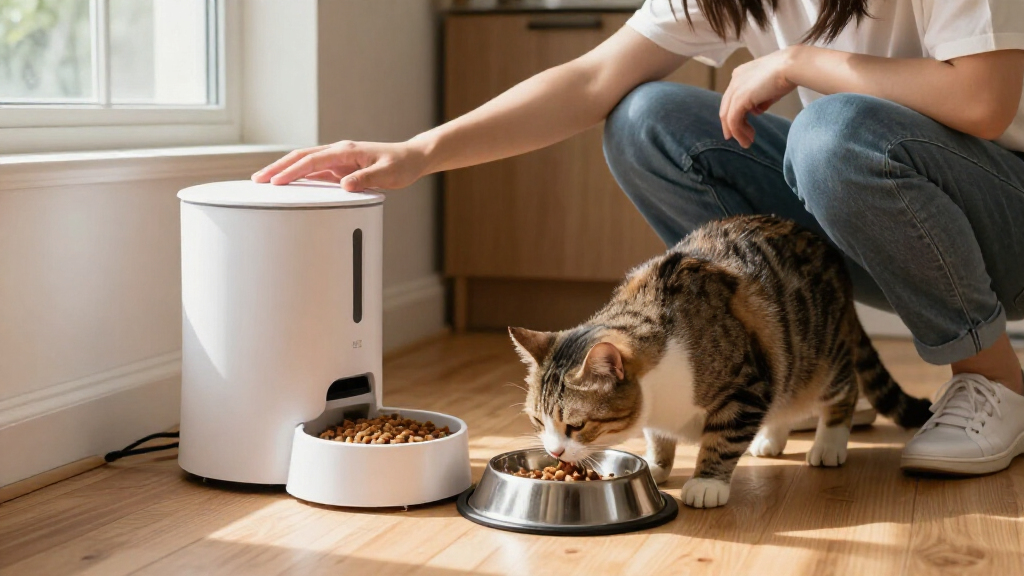
Automatic pet feeders vary from simple timed dispensers to connected models with cameras, so the right choice depends on how much control and monitoring you need. I rank the Whisker Feeder-Robot as the best overall for buyers prioritizing a feature-rich, purpose-built feeding system, while the Frienhund 2K feeder stands out for camera monitoring and the Amazon Basics gravity set for a simple food-and-water setup. The main tradeoffs are smart features versus straightforward operation, large capacity versus countertop space, and scheduled portions versus gravity-fed access. Multi-pet households also need to think about bowl access and whether one feeder can reliably serve each animal. Read on for the full comparison and a guide to matching a feeder to your household.

Get pet supplies delivered free with Prime
- Fast, free delivery on millions of items
- Prime Video, Amazon Music and more included
- Member-only deals all year
Complete the kit


Key Takeaways
- The lineup splits into two approaches: programmable feeders control meal timing, while the Amazon Basics gravity set keeps food available without scheduled portions.
- Camera-equipped models serve a different purpose from basic dispensers: the Frienhund, Inetzora, Gwozn, and camera-equipped PETLIBRO add remote viewing, but those features do not replace portion planning.
- Capacity varies widely: options range from compact 3L dispensers to the 30L Gwozn, so the largest unit is more suited to high-volume needs than to every home.
- Multi-pet feeding requires more than a larger hopper: the PETLIBRO dual-bowl model and oneisall feeder for two cats directly address shared feeding, while single-bowl models may not separate portions.
- Power and food compatibility matter as much as app features: the IMIPAW includes dual power supply, and most listed programmable models are intended for dry food, so buyers should verify backup needs and kibble fit before choosing.
| Frienhund Automatic Pet Feeder with 2K Camera, 7 L Capacity, Wi-Fi, Night Vision, and Two-Way Audio |  | Best for Camera Monitoring | Capacity: 7 L (29 cups) | Food type: Dry food | Feeding schedule: Up to 15 meals per day; up to 20 portions per meal | VIEW LATEST PRICE | See Our Full Breakdown |
| Whisker Feeder-Robot Automatic Pet Feeder, White with Smoke-Grey Hopper |  | Best for Reliable App Scheduling | Hopper capacity: 32 cups | Food type: Dry or semi-moist kibble | Meals per day: 1 to 8 | VIEW LATEST PRICE | See Our Full Breakdown |
| PETLIBRO Automatic Pet Feeder with Camera, Dual Bowls, 5L, Black |  | Best for Two Pets | Capacity: 5 L | Pet capacity: Up to 2 pets | Feeding schedule: Up to 6 meals daily; 1–50 portions per meal | VIEW LATEST PRICE | See Our Full Breakdown |
| ANDOLL HOME Automatic Pet Feeder, 4L, Programmable for Cats and Dogs |  | Best for Simple Scheduled Feeding | Capacity: 4 L | Food type: Dry food | Meals per day: Up to 8 | VIEW LATEST PRICE | See Our Full Breakdown |
| ANDOLL HOME Automatic Cat and Dog Feeder, 3L Dry Food Dispenser |  | Best Compact Voice-Call Feeder | Capacity: 3 L | Food type: Dry food | Scheduled meals: Up to 8 meals daily | VIEW LATEST PRICE | See Our Full Breakdown |
| Inetzora Automatic Pet Feeder with 2K Camera, 6L Capacity, and Dual-Band Wi-Fi |  | Best for Camera Check-Ins | Capacity: 6 L (24 cups) | Camera: 3 MP Full HD; described as 2K | Wi-Fi: 2.4 GHz and 5 GHz | VIEW LATEST PRICE | See Our Full Breakdown |
| Gwozn 30L Automatic Dog Feeder with 1080p Camera |  | Best for High-Capacity Feeding | Capacity: 30 L (about 126 US cups) | Kibble size: 2–23 mm | Wi-Fi: 2.4 GHz and 5 GHz | VIEW LATEST PRICE | See Our Full Breakdown |
| Amazon Basics Automatic Gravity Pet Food Feeder and Water Dispenser Set, 152 fl oz Food Capacity, 135.3 fl oz Water Capacity |  | Best for Simple Food-and-Water Supply | Food capacity: 152 fl oz | Water capacity: 135.3 fl oz | Operation: Gravity-fed | VIEW LATEST PRICE | See Our Full Breakdown |
| Yuposl Automatic Pet Feeder, 3L, with Stainless Steel Bowl |  | Best for No-App Feeding | Capacity: 3 L (12 cups) | Scheduled meals: 1–6 per day | Food type: Dry food | VIEW LATEST PRICE | See Our Full Breakdown |
| Voluas Automatic Cat Feeder, 4L Programmable Dry Food Dispenser |  | Best for Flexible Portion Settings | Capacity: 4 L (16.9 cups) | Meal schedule: 1–4 meals per day | Portion settings: 0–40 portions | VIEW LATEST PRICE | See Our Full Breakdown |
| oneisall Automatic Cat Feeder for Two Cats |  | Best for Feeding Two Cats Separately | Capacity: 5 L / 20 cups / 11 lb | Feeding schedule: Up to 6 meals per day | Portion size: Approximately 10 g / 1/12 cup per portion per bowl | VIEW LATEST PRICE | See Our Full Breakdown |
| PETLIBRO 5L Wi-Fi Automatic Pet Feeder with Stainless Steel Bowl |  | Best for App-Based Scheduling and Alerts | Capacity: 5 liters | Connectivity: 2.4 GHz and 5 GHz Wi-Fi; Bluetooth | Meals per day: Up to 10 | VIEW LATEST PRICE | See Our Full Breakdown |
| oneisall Automatic Cat Feeder and Water Dispenser, 8.5L Capacity |  | Best Feeder-and-Water Combo | Total capacity: 8.5 L | Food capacity: 5 L | Water capacity: 3.5 L | VIEW LATEST PRICE | See Our Full Breakdown |
| IMIPAW Automatic Cat Feeder with Programmable Meals and Dual Power Supply |  | Best Simple, Compact Pick | Capacity: 3 L / 12 cups | Meals per day: Up to 6 | Portions per day: Up to 20 | VIEW LATEST PRICE | See Our Full Breakdown |
| PETLIBRO Automatic Pet Feeder with Portion Control and Voice Meal Call, 3 L | 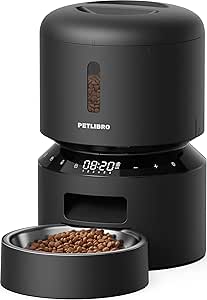 | Best for Power-Outage Backup | Capacity: 3 liters | Meal schedule: Up to 6 meals per day | Portions: 1–50 per meal; 2.5 teaspoons per portion | VIEW LATEST PRICE | See Our Full Breakdown |
| automatic pet feeder | Capacity | Power | Dimensions |
|---|---|---|---|
| Frienhund Automatic Pet Feeder | 7 L (29 cups) | DC 5 V adapter or 3 D-cell batteries | — |
| Whisker Feeder-Robot Automatic | — | — | 13 x 9 x 15 in |
| PETLIBRO Automatic Pet Feeder | 5 L | Corded electric | 12.68 x 13.78 x 13.19 in |
| ANDOLL HOME Automatic Pet Feed | 4 L | 5 V DC adapter or 3 AA batteries (not included) | 12 x 7 x 13 in |
| ANDOLL HOME Automatic Cat and | 3 L | 5 V adapter and 3 AA alkaline batteries (not included) | 12 x 7 x 13 in |
| Inetzora Automatic Pet Feeder | 6 L (24 cups) | 5V DC adapter; backup uses 3 D-cell batteries, not included | — |
| Gwozn 30L Automatic Dog Feeder | 30 L (about 126 US cups) | — | — |
| Amazon Basics Automatic Gravit | — | — | — |
| Yuposl Automatic Pet Feeder | 3 L (12 cups) | Wall power or 3 D-size alkaline batteries, not included | — |
| Voluas Automatic Cat Feeder | 4 L (16.9 cups) | 5V USB adapter or 3 D-cell batteries, not included | 7.4 × 7.4 × 11.25 in |
| oneisall Automatic Cat Feeder | 5 L / 20 cups / 11 lb | DC power; backup with 4 AA batteries, not included | 16.73 × 7.09 × 13.4 in |
| PETLIBRO 5L Wi-Fi Automatic Pe | 5 liters | Corded electric | 7.95 × 7.72 × 11.54 in |
| oneisall Automatic Cat Feeder | — | Type-C USB and 4 AA batteries | 22.6 × 6.46 × 13 in |
| IMIPAW Automatic Cat Feeder wi | 3 L / 12 cups | 5 V DC adapter or 3 D-cell batteries | 7 × 12 × 7 in |
| PETLIBRO Automatic Pet Feeder | 3 liters | USB-C and 3 D-cell batteries | 7.9 × 7.7 × 7.6 in |
More Details on Our Top Picks
Frienhund Automatic Pet Feeder with 2K Camera, 7 L Capacity, Wi-Fi, Night Vision, and Two-Way Audio
The Frienhund pairs a generous 7 L hopper with a camera and two-way audio, making it a strong fit when remote check-ins matter as much as scheduled meals. Its app supports up to 15 meals a day, more frequent scheduling than the Whisker Feeder-Robot’s eight-meal limit, while night vision and motion detection help you check on pets after dark. The removable tank and dishwasher-safe stainless steel bowl also simplify cleanup compared with the hand-wash-only Whisker.
The tradeoff is that video storage needs a TF card or cloud storage, and backup power depends on three D-cell batteries that may not be included. Choose this over the PETLIBRO dual-bowl camera feeder when capacity and a broader daily schedule matter more than serving two pets from separate bowls.
Pros:- 7 L capacity reduces how often the hopper needs refilling.
- Schedules up to 15 meals daily with up to 20 portions per meal.
- Camera includes night vision, motion detection, and two-way audio.
- Removable tank and dishwasher-safe stainless steel bowl support easier cleaning.
Cons:- Video storage requires a TF card or cloud storage.
- Three D-cell backup batteries are not specified as included.
- Dispenses dry food only.
Best for: Owners of one or more dry-food pets who want frequent scheduling, a large hopper, and remote camera check-ins.
Not ideal for: Buyers who want video recording ready without setting up a TF card or cloud storage, or who need wet-food dispensing.
- Capacity:7 L (29 cups)
- Food type:Dry food
- Feeding schedule:Up to 15 meals per day; up to 20 portions per meal
- Camera:3-megapixel; night vision and motion detection
- Wi-Fi:2.4 GHz and 5 GHz
- Video storage:TF card up to 128 GB or cloud storage
- Power:DC 5 V adapter or 3 D-cell batteries
- Bowl:Stainless steel; dishwasher-safe
Our verdict“Choose the Frienhund if a large dry-food supply and app-based camera monitoring matter more than built-in video storage or separate bowls for two pets.”
Whisker Feeder-Robot Automatic Pet Feeder, White with Smoke-Grey Hopper
The Whisker Feeder-Robot is the lineup’s straightforward app-controlled pick for people who prioritize predictable kibble portions over a camera. It schedules up to eight meals daily, tracks feeding history, and dispenses portions in 1/8-cup increments; anti-jam features and food backup detection are aimed at reducing missed meals. Its 32-cup hopper also holds more than the PETLIBRO dual-bowl feeder’s 5 L capacity, though the PETLIBRO adds video and two serving bowls.
This Whisker model accepts dry or semi-moist kibble, not wet food, and its removable parts require hand washing. It is a better match than the camera-equipped Frienhund for buyers who want feeding records without paying attention to video storage or camera features. Skip it if monitoring a pet remotely is part of the plan.
Pros:- App supports remote scheduling and feeding-history tracking.
- Anti-jam features and food backup detection help limit missed meals.
- 32-cup hopper reduces refill frequency.
- Adjustable portions use 1/8-cup increments.
Cons:- Does not dispense wet food.
- Removable parts require hand washing.
- Lacks a camera for remote visual checks.
Best for: Cat and dog owners who want app scheduling, feeding-history records, and measured kibble portions without a camera.
Not ideal for: Households needing wet-food dispensing, video monitoring, or dishwasher-safe removable parts.
- Hopper capacity:32 cups
- Food type:Dry or semi-moist kibble
- Meals per day:1 to 8
- Portion size:Up to 1/2 cup in 1/8-cup increments
- Connectivity:Wi-Fi; Whisker app
- Dimensions:13 x 9 x 15 in
- Material:Plastic
- Care:Hand wash only
Our verdict“Pick the Whisker Feeder-Robot for app-managed kibble portions and feeding records, but choose the Frienhund or PETLIBRO if camera monitoring is a priority.”
PETLIBRO Automatic Pet Feeder with Camera, Dual Bowls, 5L, Black
For households feeding two pets from one scheduled unit, the PETLIBRO dual-bowl feeder has a more useful setup than the single-bowl Frienhund: it includes two stainless steel bowls and supports up to six meals a day. Its 1080p camera, wide viewing angle, night vision, and alerts for low food, blockages, and connectivity issues add useful checks beyond the Whisker Feeder-Robot, which focuses on app scheduling and feeding history instead of video.
The limits are practical. Its 5 L capacity is smaller than the Frienhund’s 7 L, and the PETLIBRO needs a corded outlet, so it is less appealing where backup operation matters. Video storage also requires a microSD card or optional cloud service. Hand-wash-only care adds another chore, but the two-bowl arrangement makes this the clearest choice here for shared feeding.
Pros:- Two stainless steel bowls serve up to two pets from one feeder.
- 1080p camera includes infrared night vision and a 145-degree viewing angle.
- Alerts cover motion, low food, blockages, Wi-Fi issues, and malfunctions.
- Custom meal-call playback and two-way audio support remote interaction.
Cons:- 5 L capacity is smaller than the Frienhund’s 7 L hopper.
- Corded power only; no battery backup is listed.
- Video storage requires a microSD card or optional cloud storage, and parts are hand-wash only.
Best for: Owners of two indoor pets who want scheduled meals, separate bowls, and camera-based feeding checks.
Not ideal for: People who need battery backup, a larger hopper, dishwasher-safe parts, or feeding for pets that eat wet food.
- Capacity:5 L
- Pet capacity:Up to 2 pets
- Feeding schedule:Up to 6 meals daily; 1–50 portions per meal
- Camera:1080p HD; 145-degree viewing angle; infrared night vision
- Connectivity:2.4 GHz and 5 GHz Wi-Fi
- Video storage:microSD card up to 256 GB or optional cloud storage
- Power:Corded electric
- Dimensions:12.68 x 13.78 x 13.19 in
Our verdict“Choose the PETLIBRO when two pets need bowls from one camera-equipped feeder, and favor the Frienhund if hopper size or battery backup matters more.”
ANDOLL HOME Automatic Pet Feeder, 4L, Programmable for Cats and Dogs
The ANDOLL HOME 4 L keeps the job focused: scheduled dry-food meals, an alternate battery power option, and a short voice recording to call pets when food is dispensed. Its eight-meal daily limit is more modest than the Frienhund’s 15-meal schedule, but this model avoids app and camera setup for buyers who simply want a programmed routine. A swinging food mechanism is designed to help reduce blockages, while a sealed lid and desiccant compartment help protect kibble from moisture.
The 4 L capacity sits below both the Frienhund and Whisker feeders, so it suits smaller households better than pets with heavy food needs. It also lacks remote controls and alerts, and its three AA backup batteries are not included. Compared with the 3 L ANDOLL HOME model, this version offers more capacity while keeping a similar basic feature set.
Pros:- Schedules up to eight meals per day.
- Battery option can keep feeding available during power interruptions.
- Recorded 10-second message plays three times at mealtime.
- Sealed lid and desiccant compartment help protect dry food.
Cons:- Three AA backup batteries are not included.
- 4 L capacity is smaller than the Frienhund and Whisker hoppers.
- No app, camera, or remote feeding controls.
Best for: Owners of cats or smaller dogs who want scheduled dry-food portions, a voice cue, and backup power without app features.
Not ideal for: Owners who need remote monitoring, a large-capacity hopper, wet-food dispensing, or batteries included for outage backup.
- Capacity:4 L
- Food type:Dry food
- Meals per day:Up to 8
- Voice recording:10 seconds; plays 3 times at mealtime
- Power:5 V DC adapter or 3 AA batteries (not included)
- Bowl design:8-degree tilt
- Dimensions:12 x 7 x 13 in
- Care:Hand wash only; wipe clean
Our verdict“Choose this ANDOLL HOME model for uncomplicated scheduled dry-food feeding with a voice cue, but select the Frienhund for remote control and a larger hopper.”
ANDOLL HOME Automatic Cat and Dog Feeder, 3L Dry Food Dispenser
The 3 L ANDOLL HOME is the more compact-capacity choice for owners who want a simple schedule and a familiar voice cue at mealtime. It supports up to eight meals daily and plays a recorded message three times, much like the 4 L ANDOLL HOME model. The smaller hopper makes more sense for a light eater or a household with limited counter space, but it means refills will come sooner than with its 4 L sibling or the 7 L Frienhund.
A desiccant compartment and swinging food mechanism are intended to help keep kibble fresh and flowing. The feeder lacks the app controls, camera, and feeding alerts available on the PETLIBRO dual-bowl model, so it cannot provide remote checks. Backup requires three AA batteries that are not included, and plastic parts need hand washing or wiping. This is a basic scheduled dispenser, not a connected monitoring system.
Pros:- Schedules up to eight meals daily.
- Recorded voice message plays three times at feeding time.
- Desiccant compartment and swinging mechanism are designed to support freshness and food flow.
- USB power and a battery backup option provide two power choices.
Cons:- 3 L capacity means more frequent refills than the 4 L ANDOLL HOME model.
- Three AA backup batteries are not included.
- Plastic components require hand washing or wiping clean, and there is no app or camera.
Best for: Owners of one cat or a small dog who want a lower-capacity scheduled feeder with a recorded meal call.
Not ideal for: Multi-pet households, pets with high food needs, or owners who want app control, camera monitoring, or less frequent refilling.
- Capacity:3 L
- Food type:Dry food
- Scheduled meals:Up to 8 meals daily
- Voice recording:10 seconds; plays 3 times at feeding time
- Power:5 V adapter and 3 AA alkaline batteries (not included)
- Connectivity:USB
- Bowl design:8-degree tilt
- Dimensions:12 x 7 x 13 in
Our verdict“Pick the 3 L ANDOLL HOME for a compact, voice-cued routine for one light eater, but move up to the 4 L model for more hopper capacity.”
Inetzora Automatic Pet Feeder with 2K Camera, 6L Capacity, and Dual-Band Wi-Fi
The Inetzora is a strong fit for cat owners who want scheduled meals and a way to check in remotely. Its app supports up to 10 meals a day, while the camera adds infrared night vision and two-way audio for seeing and speaking to a pet between feedings. Compared with the Yuposl 3L, it offers more capacity and remote monitoring, but the Yuposl is simpler for households that prefer buttons and an LCD screen over an app. The Inetzora’s removable tank and dishwasher-safe stainless steel bowl make food-area cleanup more manageable. The tradeoffs are that cloud storage and AI Sentinel require a separate subscription after the free trial, and backup batteries are not included. Its camera and connected features also make it a more involved choice than a basic timed feeder.
Pros:- Schedules up to 10 meals per day and records feeding history in the app.
- Camera includes infrared night vision and two-way audio.
- Removable food tank and dishwasher-safe 304 stainless steel bowl simplify cleaning.
- Backup battery support can preserve scheduled feeding during a power outage.
Cons:- Cloud storage and AI Sentinel features require a separate subscription after the free trial.
- Three D-cell backup batteries are not included.
- App, camera, and Wi-Fi features add setup and connectivity needs absent from the Yuposl.
Best for: Cat owners who want app-scheduled meals, remote camera check-ins, and a washable stainless steel bowl.
Not ideal for: Buyers who want camera storage and AI features without a subscription, or who prefer a simple feeder with no app setup.
- Capacity:6 L (24 cups)
- Camera:3 MP Full HD; described as 2K
- Wi-Fi:2.4 GHz and 5 GHz
- Feeding schedule:Up to 10 meals per day; 1–15 portions per meal
- Audio:Two-way audio and recorded voice interaction
- Bowl:304 stainless steel; dishwasher-safe
- Power:5V DC adapter; backup uses 3 D-cell batteries, not included
- Warranty:One year
Our verdict“Choose the Inetzora if remote camera access matters as much as scheduled feeding and you accept subscription-dependent extras.”
Gwozn 30L Automatic Dog Feeder with 1080p Camera
The Gwozn 30L is the capacity pick for households that want to refill less often or feed several pets from one hopper. Its roughly 126-cup capacity is far beyond the Inetzora’s 6L, and its dispenser accepts kibble up to 23 mm, giving it a better fit for dogs with larger dry food. App scheduling allows up to 15 feedings daily, with a 1080p camera, night vision, and two-way audio for remote check-ins. The large hopper is not automatically an advantage: it takes up more space when assembled at full height, though the feeder can also be set up using only the lower section. A key limitation is that camera and Wi-Fi shut off on battery power. That makes backup useful for dispensing, but not for keeping remote monitoring online during an outage.
Pros:- 30 L hopper holds about 126 US cups, reducing refill frequency.
- Handles dry kibble from 2 to 23 mm with an anti-clog design.
- App supports up to 15 feedings per day.
- 1080p camera, night vision, and two-way audio support remote check-ins.
Cons:- Full-height hopper can be difficult to fit in a small feeding area.
- Camera and Wi-Fi are unavailable when operating on backup batteries.
- Removable sections help with cleaning, but the bottom motor section must stay dry.
Best for: Owners of medium, large, or giant dogs, or multi-pet households that need a large dry-kibble supply and frequent scheduled meals.
Not ideal for: People with limited floor space or buyers who need camera and Wi-Fi access to remain active during battery backup.
- Capacity:30 L (about 126 US cups)
- Kibble size:2–23 mm
- Wi-Fi:2.4 GHz and 5 GHz
- Maximum schedule:Up to 15 feedings per day
- Camera:1080p with night vision
- Audio:Two-way audio
- Backup power:3 D-cell batteries; camera and Wi-Fi disabled in battery mode
- Warranty:Two years
Our verdict“Pick the Gwozn when hopper capacity and larger kibble matter more than a compact footprint or camera access during outages.”
Amazon Basics Automatic Gravity Pet Food Feeder and Water Dispenser Set, 152 fl oz Food Capacity, 135.3 fl oz Water Capacity
This Amazon Basics gravity set is for households that want food and water available without programming schedules, installing an app, or managing batteries. Transparent hoppers make remaining supplies easy to see, and the 152 fl oz food and 135.3 fl oz water capacities give it a different purpose from timed feeders such as the Voluas 4L: it replenishes the bowls by gravity rather than portioning meals at set times. That simplicity can suit pets who graze, but it cannot control meal timing or serving size. The lightweight bases have anti-skid feet and side handles, useful for repositioning, though they may not be as secure around pets that push or tip feeding equipment. Both pieces are hand-wash only, and the food dispenser is for dry food, so this is a convenience set rather than a tool for managed feeding routines.
Pros:- Includes both a gravity-fed food dispenser and water dispenser.
- Transparent hoppers make supply levels visible at a glance.
- Wide refill openings make topping up straightforward.
- Anti-skid feet and side cut-out handles help with placement and moving.
Cons:- Gravity feeding does not schedule meals or limit portions.
- Both dispensers require hand washing.
- Food dispenser is designed for dry food only.
Best for: Cat or dog owners whose pets graze freely and who want a low-tech dry-food and water supply in one set.
Not ideal for: Owners who need timed meals, controlled portions, or an automatic feeder suited to pets on a veterinarian-directed feeding schedule.
- Food capacity:152 fl oz
- Water capacity:135.3 fl oz
- Operation:Gravity-fed
- Material:Polypropylene
- Feeder dimensions:12.5 × 7 × 12 in
- Waterer dimensions:12.4 × 7 × 12 in
- Weight:1.8 lb
- Care:Hand wash only
Our verdict“Choose this set for unscheduled grazing and automatic water replenishment, not for portion-controlled meals.”
Yuposl Automatic Pet Feeder, 3L, with Stainless Steel Bowl
The Yuposl 3L suits buyers who want scheduled meals without Wi-Fi, a smartphone, or a connected account. Its LCD and buttons set one to six meals per day, while the sealed lid and rotor help limit food access between feedings. Compared with the camera-equipped Inetzora, the Yuposl gives up remote monitoring and app control in exchange for a more self-contained routine that does not depend on a network connection. Its 3L capacity is also smaller than the Voluas 4L, so owners of larger pets may need to refill it more often. The stainless steel bowl is dishwasher-safe, and parts other than the main unit can be removed and washed. It handles dry food only, and battery operation requires three D-size batteries that are sold separately.
Pros:- LCD and button controls schedule 1–6 meals per day without an app.
- Can run on wall power or three D-size batteries.
- Stainless steel bowl is dishwasher-safe.
- Sealed lid and rotor help keep food fresh and reduce access between meals.
Cons:- Three D-size batteries are not included.
- 3 L capacity is smaller than the Voluas 4 L.
- Only parts other than the main unit are removable and washable; dry food only.
Best for: Cat owners and small-dog owners who want a straightforward, scheduled dry-food feeder that works without Wi-Fi or a smartphone.
Not ideal for: Households needing remote feeding control, camera monitoring, more than six daily meals, or a large food reservoir.
- Capacity:3 L (12 cups)
- Scheduled meals:1–6 per day
- Food type:Dry food
- Compatible kibble size:2–15 mm
- Power:Wall power or 3 D-size alkaline batteries, not included
- Bowl:Stainless steel; dishwasher-safe
- Target animals:Cats, small dogs, and small animals
- Cleaning:Parts other than the main unit are removable and washable
Our verdict“Choose the Yuposl if you want simple offline scheduling and a stainless steel bowl rather than app-based features or extra capacity.”
Voluas Automatic Cat Feeder, 4L Programmable Dry Food Dispenser
The Voluas 4L offers a practical middle ground for buyers who want programmable portions but do not need the Yuposl’s offline-first simplicity or the Inetzora’s camera. Its LCD supports one to four meals a day and up to 40 portion settings, giving owners room to adjust dry-food servings for cats, rabbits, or small dogs. A recorded meal call of up to 10 seconds can help cue pets, though it is not a substitute for remote check-ins. At 4L, it holds more than the Yuposl 3L, but its schedule is less flexible than the Gwozn’s allowance of up to 15 daily feedings. The feeder can use a USB adapter or three D-cell batteries, but the batteries are not included. Removable parts support cleaning, while the unit needs to stay indoors and dry.
Pros:- Schedules 1–4 meals per day with 0–40 portion settings.
- 4 L capacity exceeds the Yuposl 3L reservoir.
- USB adapter and optional battery power provide two power options.
- Recorded meal call can play for up to 10 seconds.
Cons:- Three D-cell batteries are not included.
- Designed for dry food only.
- The schedule allows fewer daily meals than the Gwozn, and there is no camera or app-based remote monitoring.
Best for: Owners of cats, rabbits, or small dogs who want adjustable dry-food portions, a recorded meal cue, and more capacity than a compact 3L feeder.
Not ideal for: People who need camera monitoring, more than four daily meals, or a feeder for wet food.
- Capacity:4 L (16.9 cups)
- Meal schedule:1–4 meals per day
- Portion settings:0–40 portions
- Approximate portion size:6–7 g (about 1 tablespoon or 1/16 cup)
- Food type:Dry food
- Power:5V USB adapter or 3 D-cell batteries, not included
- Voice recording:Up to 10 seconds
- Dimensions:7.4 × 7.4 × 11.25 in
Our verdict“Choose the Voluas if customizable portions and a recorded meal call matter more than camera access or a high number of daily feedings.”
oneisall Automatic Cat Feeder for Two Cats
Among these five feeders, this one is the clearest fit for a two-cat household that needs scheduled meals at separate bowls. Its 16-inch bowl spacing gives cats room to eat apart, while the other oneisall option in this lineup combines food dispensing with a gravity water dispenser instead of offering this two-bowl setup. You can schedule up to six meals daily and adjust portions, and the 5 L hopper reduces how often it needs refilling. A 10-second voice recording can add a familiar mealtime cue, and the sealed container with desiccant helps protect dry food. The tradeoffs are a narrower kibble limit of under 0.5 inch and a main unit that cannot be washed with water; only the bowls are dishwasher-safe. Backup batteries also need to be purchased separately.
Pros:- Two stainless steel bowls sit 16 inches apart for separate feeding.
- Schedules up to six meals per day with adjustable portions.
- 5 L hopper and desiccant support longer intervals between refills and help keep kibble fresh.
- Dishwasher-safe bowls and a 10-second voice recorder.
Cons:- Limited to kibble smaller than 0.5 inch.
- The main feeder unit is not water-washable.
- Four AA backup batteries are not included.
Best for: Households with two cats that eat at separate bowls and need scheduled dry-food meals.
Not ideal for: Owners whose cats eat kibble 0.5 inch or larger, or who want a feeder whose whole unit can be washed.
- Capacity:5 L / 20 cups / 11 lb
- Feeding schedule:Up to 6 meals per day
- Portion size:Approximately 10 g / 1/12 cup per portion per bowl
- Maximum kibble size:Less than 0.5 in
- Bowl spacing:16 in
- Power:DC power; backup with 4 AA batteries, not included
- Dimensions:16.73 × 7.09 × 13.4 in
- Cleaning:Stainless steel bowls are dishwasher-safe; main unit is not water-washable
Our verdict“Choose this one for two cats that need scheduled portions at spaced bowls, but skip it if your kibble is too large or easy full-unit cleanup is a priority.”
PETLIBRO 5L Wi-Fi Automatic Pet Feeder with Stainless Steel Bowl
This PETLIBRO is the most connected choice in this group: its app supports up to 10 meals per day, feeding records, and 1–48 portions per meal. That flexibility makes it better suited to owners who want to adjust a routine remotely than the simpler button-programmed IMIPAW, which schedules up to six meals. The low-food, jam, and low-battery alerts can help flag problems before a missed feeding goes unnoticed, while the sealing components and desiccant help protect kibble between meals. Its 5 L capacity is useful for fewer refills, and the stainless steel bowl offers a cleanable food-contact surface. The app features come with more setup and connectivity dependence than a basic feeder, and it accepts only 2–15 mm kibble. The base should not be washed, and the listed power source is corded electric.
Pros:- App scheduling supports up to 10 meals per day and 1–48 portions per meal.
- Feeding records and alerts cover low food, jams, and low battery.
- Twist-lock lid, sealing components, and desiccant help protect kibble.
- Stainless steel bowl is designed for hygienic feeding.
Cons:- Only suitable for kibble measuring 2–15 mm in diameter.
- The feeder base should not be washed.
- App control relies on a compatible Wi-Fi connection.
Best for: Pet owners who want to set detailed meal schedules remotely and receive alerts about food supply or dispensing problems.
Not ideal for: Buyers who prefer a simple offline control panel, need a feeder for larger kibble, or want the feeder base to be washable.
- Capacity:5 liters
- Connectivity:2.4 GHz and 5 GHz Wi-Fi; Bluetooth
- Meals per day:Up to 10
- Portions per meal:1–48
- Portion size:1/12 cup
- Kibble diameter:2–15 mm
- Dimensions:7.95 × 7.72 × 11.54 in
- Power:Corded electric
Our verdict“Pick this PETLIBRO for remote schedule control and status alerts; choose the IMIPAW instead if straightforward local programming matters more than app features.”
oneisall Automatic Cat Feeder and Water Dispenser, 8.5L Capacity
If the goal is to automate both food and water without buying separate stations, this oneisall fills a role none of the other four does. It pairs a 5 L timed food hopper with a 3.5 L gravity water dispenser, while the PETLIBRO Wi-Fi model focuses on more elaborate app scheduling and alerts for food. The feeder offers adjustable portions and one to six meals per day, and its USB-C plus four-AA power options provide a backup path during outages. Stainless steel bowls are dishwasher-safe, which helps with routine bowl cleaning. The water side is gravity-fed, not electronically filtered or pumped, so it will not circulate or filter water. Its long footprint may also be less convenient in a narrow feeding area, and batteries are not included. I’d choose it for a combined feeding station, not for remote monitoring or advanced water care.
Pros:- Combines timed dry-food dispensing with a 3.5 L gravity water reservoir.
- Supports one to six meals per day with adjustable portions.
- USB-C and four-AA battery support offer an alternate power source during outages.
- Dishwasher-safe stainless steel bowls.
Cons:- Gravity water dispensing has no electronic pump or filtration.
- The 22.6-inch length may take up substantial floor space.
- Four AA batteries are not included.
Best for: Cat owners who want a scheduled dry-food feeder and a gravity water supply in one station, with backup power available.
Not ideal for: Owners who need app alerts, water filtration or circulation, or a compact feeder for a small feeding nook.
- Total capacity:8.5 L
- Food capacity:5 L
- Water capacity:3.5 L
- Feeding schedule:1–6 meals per day
- Materials:BPA-free plastic and stainless steel
- Power:Type-C USB and 4 AA batteries
- Dimensions:22.6 × 6.46 × 13 in
- Weight:3 kg
Our verdict“Choose this model when combining food scheduling and gravity-fed water matters more than app control or filtered water.”
IMIPAW Automatic Cat Feeder with Programmable Meals and Dual Power Supply
The IMIPAW keeps the job focused: timed dry-food portions, a compact 3 L hopper, and a removable tray. Its up-to-six-meal schedule is enough for many everyday routines, though the PETLIBRO Wi-Fi feeder offers more frequent scheduling, app controls, and alerts for owners who want closer oversight. Here, the appeal is simpler programming paired with dual power options: a 5 V adapter or three D-cell batteries can keep the feeder powered if household electricity fails, though those batteries are not included. The hopper holds less than the 5 L options from oneisall and PETLIBRO, so owners will refill it more often. The removable tray helps with cleanup, but it is hand-wash only, and the feeder is designed for dry food. It suits buyers seeking basic scheduled portions without app features or a combined water station.
Pros:- Schedules up to six meals per day and 20 portions daily.
- Adapter or three D-cell batteries provide two power options.
- Removable tray and secure lid simplify routine handling.
- Desiccant bag helps keep dry food fresh.
Cons:- The 3 L capacity means more frequent refills than the 5 L feeders in this lineup.
- Removable tray requires hand washing.
- Backup D-cell batteries are not included, and the feeder is for dry food only.
Best for: Owners of a cat or small pet who want a compact, straightforward dry-food feeder with scheduled meals and battery backup capability.
Not ideal for: Households needing a large hopper, app-based monitoring, or dishwasher-safe feeder components.
- Capacity:3 L / 12 cups
- Meals per day:Up to 6
- Portions per day:Up to 20
- Serving size:Approximately 7–9 g
- Power:5 V DC adapter or 3 D-cell batteries
- Food type:Dry food
- Dimensions:7 × 12 × 7 in
- Cleaning:Hand wash only; removable tray
Our verdict“Choose the IMIPAW for basic scheduled feeding in a smaller setup, but opt for a 5 L model if refill frequency or app control is a priority.”
PETLIBRO Automatic Pet Feeder with Portion Control and Voice Meal Call, 3 L
This 3 L PETLIBRO makes the most sense for owners who want a conventional programmed feeder with a backup power plan and a familiar mealtime call. It schedules up to six meals per day, with 1–50 units per meal, and pairs USB-C power with three D-cell batteries. Compared with the app-connected PETLIBRO 5L, this model trades remote scheduling and status alerts for a smaller, more direct setup; its 10-second voice recording and infrared obstruction detection add useful details without app control. The twist-lock lid, sealing strip, and desiccant help protect dry kibble, though the 3 L capacity calls for more frequent refills than the larger 5 L models. It also only handles 2–15 mm kibble, and the base must not be washed. Battery life is listed at about 30–50 days.
Pros:- USB-C power and three D-cell batteries provide backup during outages.
- Schedules up to six meals daily with 1–50 portions per meal.
- Voice meal call and infrared obstruction detection add convenience and a safety response.
- Twist-lock lid, sealing strip, and desiccant help protect stored kibble.
Cons:- The 3 L hopper needs refilling more often than the 5 L options.
- Only compatible with dry kibble measuring 2–15 mm.
- The feeder base must not be washed.
Best for: Owners who want scheduled portions, a recorded meal call, and battery backup for a smaller indoor pet-feeding setup.
Not ideal for: Buyers who need remote app controls, a larger hopper, or a feeder suited to kibble outside the 2–15 mm range.
- Capacity:3 liters
- Meal schedule:Up to 6 meals per day
- Portions:1–50 per meal; 2.5 teaspoons per portion
- Power:USB-C and 3 D-cell batteries
- Battery life:About 30–50 days
- Kibble diameter:2–15 mm
- Dimensions:7.9 × 7.7 × 7.6 in
- Voice recording:10 seconds
Our verdict“Choose this PETLIBRO for power backup and a recorded meal call in a smaller feeder, but pick its 5 L Wi-Fi counterpart for remote controls and alerts.”
How We Picked
I compared these automatic pet feeders by how well their design matches everyday feeding needs: meal scheduling and portion control, food capacity, bowl arrangement, monitoring features, power options, and ease of routine care. I also weighed whether a feature solves a practical problem or adds setup and maintenance demands. A camera can help an owner check in remotely, for example, but it is not a substitute for a feeder that dispenses the right food reliably.
The ranking gives priority to useful feeding control and household fit, then considers added capabilities such as cameras, dual bowls, and larger storage. That is why the Whisker Feeder-Robot leads as a broad-use pick, while specialized options rank for clearer needs such as two-pet feeding, remote monitoring, or simple gravity dispensing. Since the product list does not provide verified comparative reliability or exact portion accuracy, I avoid treating those as established advantages and recommend checking manufacturer guidance for food size, cleaning, and backup operation.
Factors to Consider When Choosing Automatic Pet Feeders
Before choosing among automatic pet feeders, start with the feeding routine you need to preserve. A feeder can simplify timing, but it cannot resolve every issue around food stealing, diet restrictions, or a pet that needs supervision. These factors help separate useful automation from features you may not need.
Match the Feeder to Your Pet’s Meal Schedule
Count the meals your pet eats and decide whether the feeder needs to support a fixed routine, occasional schedule changes, or remote adjustments. A programmable dispenser can help maintain regular dry-food meals when nobody is home, but it does not automatically address special feeding instructions or medication routines. Check how the manufacturer defines a portion; a preset serving may not match your pet’s measured daily allowance. A common mistake is to choose a feeder by meal count alone without checking portion increments. Ask your veterinarian for feeding guidance if your pet’s diet needs close control. If your schedule is already consistent and food can remain available, a timed model may add complexity without much benefit.
Choose Capacity for Your Household, Not Just Convenience
Feeder capacity affects how often you refill, but a larger hopper also takes up more room and can be harder to handle during cleaning. Estimate consumption using your pet’s actual daily ration rather than the advertised capacity alone, since kibble shape and density affect how much fits. Large-capacity choices such as the 30L Gwozn suit a different scale of use from 3L or 4L dispensers, but size by itself says nothing about portion precision. Check whether the feeder fits beneath cabinets or on the surface where your pet eats. For longer trips, remember that a full hopper does not provide human supervision or confirm that your pet has eaten. Pick the smallest capacity that comfortably fits your refill routine and household space.
Plan for More Than One Pet
A feeder advertised for two pets may offer separate bowls, but that does not guarantee that each animal receives the intended share. Consider whether your pets eat at the same pace, guard food, or follow different diets. A dual-bowl design can make shared access more convenient, yet it may still leave both animals able to reach the same food supply. If food theft or diet separation is a concern, separate feeding locations or pet-specific access controls may matter more than hopper size. Measure the available floor space and think about whether both pets can eat comfortably at once. When one animal needs a restricted diet, ask the manufacturer how the design limits access rather than assuming two bowls solve the problem.
Decide Whether a Camera or App Solves a Real Need
Camera-equipped feeders can offer a remote view of the feeding area and, on some models, audio features or app-based controls. These functions make the most sense when you want to check in while away or adjust a routine remotely. They also add setup steps and depend on a suitable network connection, so confirm the feeder’s Wi-Fi requirements before buying. A camera shows activity in its field of view; it does not prove that the correct pet ate the food or that a meal was fully consumed. Think about where the feeder will sit, since a poor angle can limit what the camera captures. If you only need scheduled dispensing, a simpler model may be easier to maintain.
Check Food Compatibility and Cleaning Access
Most models in this roundup are designed for dry food, but kibble dimensions and shape can affect dispensing. Compare the food your pet already eats with the manufacturer’s stated size limits, especially if the kibble is unusually small, large, or irregular. Look for removable food-contact parts and clear cleaning instructions; residue and crumbs can collect around bowls and dispensing openings. Stainless steel bowls appear on several options, which may suit buyers who prefer that bowl material, but the rest of the feeder still needs routine care. Do not assume a camera or app-connected unit will be easy to clean simply because it is automated. A practical feeder is one you can refill and wash without disrupting the whole feeding setup.
Treat Backup Power as Part of the Feeding Plan
A scheduled feeder depends on power, and connected features may depend on both electricity and network access. The IMIPAW listing specifies dual power supply, making backup operation a relevant point to investigate, but buyers should check what batteries are required and which functions remain active during an outage. A backup option can protect scheduled meals from a brief interruption, though it does not make a feeder maintenance-free. Ask whether settings persist after power loss and whether the unit signals a low battery or dispensing problem. If meals must happen at precise times, have a manual backup plan rather than relying on connectivity alone. Match the level of backup to your pet’s feeding needs and how quickly someone can reach your home.
Frequently Asked Questions
Can an automatic pet feeder replace a person checking on my pet?
No. A feeder can dispense meals on a schedule, and a camera model may let you view the feeding area, but neither confirms your pet’s overall wellbeing. It cannot respond if food jams, the power fails, or your pet becomes ill. For time away from home, arrange a person to check in at a frequency suited to your pet. Treat automation as support for a routine, not as a substitute for care.
Is a camera feeder worth choosing over a basic programmable model?
Choose a camera model if seeing the feeding area remotely would change how you manage your day or help you check whether a meal was dispensed. The Frienhund, Inetzora, Gwozn, and camera-equipped PETLIBRO options add monitoring, but camera functions do not automatically improve portion control. A basic programmable feeder may be a better fit if your main goal is regular meal timing. Before paying for connected features, check Wi-Fi compatibility, app requirements, and whether the camera view suits the intended placement.
Will one feeder work for two pets with different diets?
Usually, a shared feeder is not the safest way to manage different diets unless the design can restrict each pet’s access as needed. The PETLIBRO dual-bowl model and oneisall feeder for two cats address shared feeding layouts, but separate bowls do not necessarily prevent food swapping. If either pet has a prescribed diet, consider separate feeding stations or a feeder with verified pet-specific access controls. Confirm the manufacturer’s access-control details before relying on a shared unit. Ask your veterinarian how strictly the diets need to be separated.
Should I choose a gravity feeder or a scheduled feeder?
A gravity feeder replenishes the bowl as food is eaten, so it suits households where free access is appropriate and meal portions do not need to be timed. A scheduled dispenser is a better match when you want meals released at set times or need more structure around feeding. Gravity dispensing does not control how much a pet eats, which can be a concern for animals that overeat. Scheduled models still require you to set suitable portions and monitor how your pet responds. Let your pet’s feeding plan, rather than convenience alone, guide this choice.
How much feeder capacity do I need if I travel?
Capacity depends on your pet’s daily food amount and how often someone can refill the feeder, not just the length of a trip. Use the manufacturer’s stated capacity as a starting point, then account for kibble size and the possibility that the unit needs cleaning or attention. A larger hopper reduces refill frequency but does not provide supervision or protect against every dispensing issue. For travel, arrange a person to check food, water, and your pet rather than relying on a full container alone. Also check backup-power instructions and confirm the schedule before you leave.
Conclusion
For most buyers seeking a feature-rich scheduled feeder, I recommend the Whisker Feeder-Robot as the best overall pick in this lineup. The Amazon Basics gravity set is the best value-style choice for households that want uncomplicated food and water access rather than timed portions, while the camera-equipped Frienhund is my best premium-style option for owners who value remote monitoring and two-way audio. Beginners who want a straightforward programmable dry-food dispenser can start with the ANDOLL HOME 4L or Voluas 4L, after checking the setup and portion instructions. For two-pet households, compare the PETLIBRO dual-bowl and oneisall two-cat models, but use separate feeding arrangements when pets need different diets. If you need very high capacity, investigate the Gwozn 30L; for backup-power flexibility, look closely at the IMIPAW. The right choice is the one that fits your pet’s feeding plan and your ability to monitor the routine.