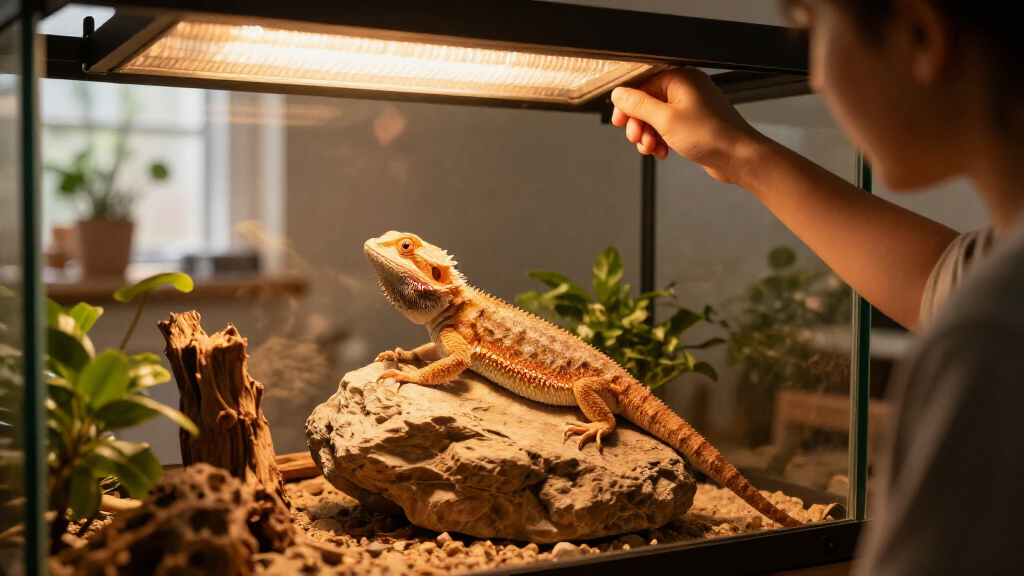
Reptile heating lamps create a warm basking area, but the right choice depends on your enclosure, the temperatures your animal needs, and whether you need daytime light or nighttime heat. I rank the REPTI ZOO 100W two-pack as the best overall for a straightforward basking setup, while the LUCKY HERP 150W ceramic emitter stands out for heat without visible light and the TFNN double-head lamp for an all-in-one fixture with a timer. The main tradeoffs are bulb-only simplicity versus fixture convenience, visible light versus dark nighttime heating, and higher wattage versus more manageable heat output. A lamp that suits one enclosure may run too hot or provide the wrong kind of heat in another. Read on for the full comparison and a guide to matching a lamp to your habitat.

Get pet supplies delivered free with Prime
- Fast, free delivery on millions of items
- Prime Video, Amazon Music and more included
- Member-only deals all year
Complete the kit



Key Takeaways
- Bulb-only picks lead on setup flexibility: REPTI ZOO, REPTI HOME, Fluker’s, and Lucky Herp let you choose a compatible fixture separately, unlike the clamp-and-bulb TFNN and DaToo options.
- The ceramic emitter serves a distinct purpose: LUCKY HERP’s 150W ceramic bulbs provide heat without visible light, making them more suitable for nighttime heating than daylight basking bulbs.
- Integrated fixtures trade flexibility for convenience: TFNN‘s double-head model adds two bulbs and an intelligent cycle timer, while its single-head 50W/75W kit keeps the setup simpler.
- Wattage alone does not identify the right lamp: The lineup ranges from 25W and 50W bulbs to 150W emitters, so enclosure size, distance, ventilation, and measured temperatures matter more than the biggest number.
- Purpose matters more than a UVA/UVB label: Several kits describe bulbs as UVA/UVB, but buyers should check the exact lamp specifications and use a dedicated UVB source when their species requires one.


| reptile heating lamp | Wattage | Bulb base | Voltage |
|---|---|---|---|
| REPTI ZOO 100W Reptile Heat La | 100 watts per bulb | E26 | 110 volts |
| REPTI HOME Reptile Heat Lamp B | 100 watts per bulb | E26 | 120 volts |
| Fluker’s Incandescent Basking | 100 watts (title and description) | — | 120 volts |
| Lucky Herp Reptile Heat Lamp B | 100 watts | E26 | 120 volts |
| LUCKY HERP 150W Ceramic Heat E | 150 watts | E26 | 120 volts |
| TFNN Double-Head Reptile Heat | — | E26 | — |
| TFNN Reptile Heat Lamp with Cl | — | — | — |
| DaToo 50W Reptile Heat Lamp wi | 50W | E27 | — |
| Reptile Heat Lamp with 50W UVA | 50W | — | — |
More Details on Our Top Picks
REPTI ZOO 100W Reptile Heat Lamp Bulbs, 2-Pack
I’d choose the REPTI ZOO 100W two-pack for a straightforward daytime basking setup where a focused warm area and UVA are both wanted. Its reflector shape directs heat toward the basking zone, unlike the light-free LUCKY HERP ceramic emitters, which provide warmth but no visible light. Standard E26 compatibility also makes it easy to pair with a suitable fixture, while two bulbs give you a replacement on hand.
The tradeoff is the 100W draw per bulb, and the product details don’t give a target temperature or recommended mounting distance. I’d use an appropriate thermostat or temperature checks to manage enclosure conditions rather than assume the wattage fits every terrarium. Compared with the REPTI HOME bulbs, this one lists a longer maximum operating life, but its brightness is specified at only 100 lumens.
Pros:- Provides both heat and UVA for daytime basking
- Reflector shape focuses heat toward a basking area
- Two bulbs provide a replacement without a separate purchase
- Rated for up to 3,000 hours of use
Cons:- Each bulb draws 100 watts
- No temperature output or recommended distance is specified
- The listed brightness is 100 lumens
Best for: Reptile keepers seeking a standard E26 daytime basking bulb with UVA and a spare bulb for routine replacement.
Not ideal for: Keepers who need light-free nighttime heat or specific guidance on basking distance and temperature output.
- Pack size:2 bulbs
- Wattage:100 watts per bulb
- Bulb type:Incandescent
- Bulb base:E26
- Voltage:110 volts
- Brightness:100 lumens
- Operating life:Up to 3,000 hours
Our verdict“Choose this two-pack for focused daytime heat and UVA in an E26 fixture, but plan to measure enclosure temperatures yourself.”
REPTI HOME Reptile Heat Lamp Bulbs, 2-Pack, 100W
The REPTI HOME 100W two-pack suits keepers who want a spare ready when a basking bulb needs replacement. It provides concentrated heat for reptiles and amphibians, and its E26 base fits standard compatible sockets. Compared with the REPTI ZOO two-pack, it gives a more defined light-output figure at 450 lumens, while its stated service life is lower and less consistent across the product details.
There are firm setup limits: these bulbs are for indoor, dry use, must stay at least 30 cm from animals, and aren’t recommended with dimmers, thermostats, or rheostats. That makes them a less flexible choice than a setup designed for controlled dimming. I’d favor them for a basic basking arrangement with carefully monitored temperatures, not for keepers who need the lamp itself to work with a thermostat or variable output.
Pros:- Includes two bulbs, allowing one to serve as a spare
- Designed to create a concentrated basking area
- E26 base fits compatible standard sockets
- Specified at 450 lumens
Cons:- Not recommended for use with dimmers, thermostats, or rheostats
- Must be kept dry and at least 30 cm from animals
- Operating-life information varies between the description and specifications
Best for: Keepers with an indoor E26 basking fixture who want a backup bulb and can manage heat through placement and temperature monitoring.
Not ideal for: Owners who need thermostat, dimmer, or rheostat compatibility, or who need a lamp for damp or outdoor conditions.
- Quantity:2 bulbs
- Wattage:100 watts per bulb
- Bulb shape:A19
- Bulb base:E26
- Voltage:120 volts
- Light output:450 lumens
- Recommended distance:At least 30 cm from animals
Our verdict“Pick this set for a simple, dry indoor basking setup with a spare bulb, but skip it if your heat control depends on dimming or a thermostat.”
Fluker’s Incandescent Basking Spotlight Bulbs for Reptile Tanks – 100 Watt Heat Lamp
The Fluker’s 100W incandescent spotlight is the pick here when a brighter basking lamp is a priority. Its listed 1,600 lumens and 5,500 K color temperature make it a much brighter option on paper than the REPTI ZOO bulb, listed at 100 lumens. It also uses a common E26 base and is described as producing infrared heat, so it can serve as a daytime heat-and-light source in a compatible fixture.
The product details need careful reading: the title and description identify a 100W incandescent bulb, while the specs also list 7.87W power consumption, which conflicts with that rating. I wouldn’t rely on the latter figure without clarification. Unlike the LUCKY HERP ceramic emitter, it emits visible light, so it isn’t the choice for dark nighttime heating; the provided data also gives no operating-life figure.
Pros:- Listed output of 1,600 lumens provides a bright basking light
- Description identifies infrared heat for basking
- Uses a standard E26 base
- Lists a 5,500 K color temperature
Cons:- Power consumption is listed as 7.87W despite the 100W product title and description
- No operating-life figure is provided
- Visible light makes it unsuitable when darkness is needed for nighttime heating
Best for: Keepers who want a bright visible basking spotlight in a standard E26 fixture and can verify the bulb’s electrical specifications before use.
Not ideal for: Owners seeking light-free nighttime heat or buyers who need clear, consistent power-consumption and lifespan information.
- Wattage:100 watts (title and description)
- Bulb shape:A15
- Base type:E26
- Voltage:120 volts
- Color temperature:5,500 K
- Lumens:1,600 lumens
- Listed power consumption:7.87 watts
Our verdict“Choose Fluker’s for a bright daytime basking spotlight only after confirming its conflicting power details, and choose a ceramic emitter for dark nighttime heat.”
Lucky Herp Reptile Heat Lamp Bulbs 100W UVA Daylight Basking Bulbs – 2 Pack
The Lucky Herp 100W two-pack is tailored to daytime setups that call for heat, visible light, and UVA from one bulb. Its reflector shape directs output toward the basking area, and the listed 1,650 lumens make it a brighter option than the REPTI ZOO bulb’s 100-lumen specification. The standard E26 base keeps fixture choice familiar, and the two-pack includes a backup.
That brighter, high-heat approach also brings a placement burden: the description warns that the bulb generates significant heat, so enclosure temperatures and distance need close attention. Its 2,000-hour rated life is shorter than the up-to-3,000-hour figure for REPTI ZOO, and, like other incandescent choices here, it draws 100W. I’d pick it for a daylight basking zone, not for light-free night heat; the LUCKY HERP ceramic emitter fills that different role.
Pros:- Combines heat and UVA for daytime basking
- Reflector shape directs light and warmth toward a basking area
- Listed brightness is 1,650 lumens
- Two-pack includes a replacement bulb
Cons:- Draws 100 watts and generates significant heat
- Rated operating life is 2,000 hours
- Requires careful placement and temperature monitoring
Best for: Keepers who want a bright UVA daylight basking bulb, a reflector-style beam, and a spare for a compatible E26 ceramic socket.
Not ideal for: Owners needing dark nighttime heat, lower-wattage heating, or a longer stated service life than 2,000 hours.
- Pack quantity:2 bulbs
- Wattage:100 watts
- Bulb base:E26
- Voltage:120 volts
- Brightness:1,650 lumens
- Operating life:2,000 hours
- Shape:Reflector (R)
Our verdict“Choose this for a bright, reflector-style UVA basking zone, but use the ceramic LUCKY HERP emitter instead when nighttime heat must not add light.”
LUCKY HERP 150W Ceramic Heat Emitter Bulbs, 2-Pack
For heat without visible light, the LUCKY HERP 150W ceramic emitters serve a different purpose from every incandescent basking bulb in this group. They produce infrared warmth without light, so they can maintain heat at night without adding a bright lamp to the enclosure. Their standout 10,000-hour rated life is also longer than the stated lifespans of the REPTI ZOO and Lucky Herp 100W bulbs.
This is not a daytime basking-light replacement: it provides no visible light or UVA. At 150W, each emitter may also be too powerful for some enclosures, and the product requires a compatible ceramic lamp holder plus a distance greater than 30 cm from reptiles. Compared with the REPTI HOME 100W bulbs, it offers light-free heat but lacks their visible basking illumination. I’d treat it as a heat source and choose lighting separately where needed.
Pros:- Emits infrared heat without visible light
- Rated for up to 10,000 hours of use
- Two emitters are included
- Ceramic construction is designed for heat-emitter use
Cons:- Produces no visible light or UVA
- Each emitter draws 150 watts, which may be excessive for some enclosures
- Requires a compatible ceramic lamp holder and more than 30 cm of clearance
Best for: Keepers who need nighttime warmth without visible light and have a suitable ceramic-rated fixture with enough clearance from the animal.
Not ideal for: Owners seeking a single bulb for both visible daytime basking light and heat, or those without a compatible ceramic lamp holder.
- Pack quantity:2
- Wattage:150 watts
- Voltage:120 volts
- Bulb shape:A19
- Bulb base:E26
- Material:Ceramic
- Light emission:None
- Operating life:Up to 10,000 hours
Our verdict“Choose this two-pack for light-free nighttime heat in a suitable fixture, but pair it with a separate daytime lighting source.”
TFNN Double-Head Reptile Heat Lamp with Clamp, UVA/UVB Intelligent Cycle Timer, 2 Bulbs 25W+50W
The TFNN Double-Head is the strongest fit here for keepers who want two separately aimed light heads and a repeatable daily schedule. Its cycle timer turns the lamps on and off at the same time each day, cutting down on manual switching, while the 360-degree goosenecks make it easier to direct coverage across a wider enclosure. Compared with the single-head DaToo 50W, this setup offers more placement flexibility, but its 25W and 50W bulbs do not provide the same straightforward single-bulb setup. The listing claims UVA/UVB output; buyers should still verify that the lamp’s UV output and distance suit their animal’s husbandry needs. There is no dimming or intensity adjustment, and the clamp may not fit every enclosure securely, so it is less suitable for tanks with unusual rims or layouts.
Pros:- Two heads can cover a broader area or be aimed at separate spots.
- Automatic daily cycle reduces the need for manual switching.
- 360-degree goosenecks allow flexible positioning.
- Includes 25W and 50W bulbs for differing lamp needs.
Cons:- No dimming or adjustable intensity control.
- Clamp compatibility may vary across enclosure types.
- The stated UVA/UVB output should be checked against the animal’s specific UV requirements.
Best for: Keepers with a wider enclosure who want two lamp heads and a consistent automatic on/off routine.
Not ideal for: Owners who need adjustable heat intensity, a secure fit on an unusual enclosure rim, or independently verified UV output.
- Bulb wattages:25W and 50W
- Number of light sources:2
- Bulb base:E26
- Timer:Intelligent daily on/off cycle
- Gooseneck rotation:360 degrees
- Materials:Ceramic, glass, metal, and plastic
- Item weight:0.85 kg
- Dimensions:12 x 12 x 12 inches
Our verdict“Choose this TFNN if you want timed, two-head coverage and can confirm the clamp and claimed UV output suit your setup.”
TFNN Reptile Heat Lamp with Clamp and Timer, 50W and 75W Bulbs
This TFNN is the more adjustable choice for keepers who want to vary lamp output and session length without changing bulbs. It includes 50W and 75W incandescent bulbs, three brightness levels, and timer settings of 3, 6, or 12 hours. That gives it more day-to-day control than the Double-Head TFNN, whose timer follows a daily cycle but offers no dimming. Its 15.8-inch, 360-degree swan neck also helps position the lamp over a chosen area, though it remains a single clamp-mounted fixture rather than a two-head coverage solution. The tradeoff is that the supplied information does not establish UVB output, so I would not treat it as a substitute for a dedicated UVB source when an animal needs one. It also calls for careful monitoring: brightness settings are not a replacement for measuring basking temperatures.
Pros:- Includes two bulbs with different wattages.
- Three timer durations allow shorter or longer heating sessions.
- Three brightness levels provide more adjustment than fixed-output options.
- Long, rotating swan neck helps direct the lamp.
Cons:- UVB output is not specified in the provided product details.
- Brightness settings do not replace checking actual basking temperatures.
- A single head offers less coverage flexibility than the Double-Head TFNN.
Best for: Keepers who want multiple heat-session lengths and brightness settings from a clamp-mounted lamp.
Not ideal for: Owners seeking a two-head fixture or a lamp with clearly specified UVB output for species that require it.
- Bulb wattages:50W and 75W
- Total wattage:125W
- Number of light sources:2
- Mounting type:Clamp mount
- Timer modes:3, 6, and 12 hours
- Brightness levels:3
- Neck length and rotation:15.8 inches; 360 degrees
- Materials:Ceramic, metal, and plastic
Our verdict“Pick this TFNN for adjustable lamp sessions and brightness, but plan a separate UVB source if your reptile requires one.”
DaToo 50W Reptile Heat Lamp with UVA/UVB Bulb and Clamp
The DaToo keeps the setup simple: one 50W halogen bulb, a clamp, and a rotatable head for aiming heat at a basking area. Compared with the dual-bulb TFNN models, it has fewer controls and less coverage flexibility, but it is a more direct fit for someone who wants a single lamp rather than multiple heads or timer modes. Its listed 97% UVA and 3% UVB claims deserve careful checking against species-specific UV needs; a percentage alone does not tell a keeper the UV exposure at the animal’s basking distance. The main practical constraints are substantial: it needs at least 12 inches of clearance, its instructions limit heating sessions to six hours, and it should stay away from damp areas and flammable or plastic objects. That makes placement and routine monitoring part of the decision, not an afterthought.
Pros:- Single 50W halogen bulb offers a straightforward basking setup.
- 360-degree rotatable head helps direct the light.
- Clamp is designed for tanks, terrariums, and cages.
- Ceramic socket and aluminum alloy housing are specified.
Cons:- Requires at least 12 inches of clearance from the surface.
- Instructions say heating sessions should not exceed six hours.
- Must be kept away from damp areas and flammable or plastic items.
Best for: Keepers who need one clamp-mounted 50W basking lamp and can provide the stated clearance and supervised heating sessions.
Not ideal for: Owners with low-clearance enclosures, damp setups, or a need for longer unattended heating periods.
- Wattage:50W
- Light type:Halogen
- Bulb base:E27
- Listed UVA/UVB:97% UVA, 3% UVB
- Bulb lifespan:2,000–3,000 hours
- Head adjustment:360-degree rotation
- Minimum clearance:12 inches
- Warranty:1 year
Our verdict“Choose the DaToo for a basic, single-bulb basking station only if your enclosure allows its clearance and session limits.”
Reptile Heat Lamp with 50W UVA UVB Light Bulb, Basking Spot Light Simulated Sunlight, Heating Lamp for Turtle, Lizard, Snake, Bearded Dragon, Amphibians
The DOMICA stands out for a compact clip-and-bulb format with a 360-degree rotating clip, reinforced ceramic base, and aluminum alloy coating. At 0.34 kg, it is lighter than the Double-Head TFNN and does not add a second lamp head or timer controls to the enclosure. Its stated 3,000-hour operating life and E27 socket, listed as compatible with 10–75W bulbs, give buyers some flexibility when replacing or changing bulbs. There is a notable caveat: despite the product title’s UVA/UVB wording, the supplied details say it has no built-in UVB output and needs a separate UV bulb. It also requires at least 10 inches of clearance and must be kept away from plastic components. Compared with the DaToo, it has a lower stated clearance requirement, but both need deliberate placement.
Pros:- Lightweight 0.34 kg body with a 360-degree rotating clip.
- Reinforced ceramic base and aluminum alloy coating are specified.
- E27 socket is listed as compatible with 10–75W bulbs.
- Listed operating life is 3,000 hours.
Cons:- No built-in UVB output; a separate UV source is needed when required.
- Requires at least 10 inches of clearance to reduce overheating risk.
- Plastic components nearby can limit placement options.
Best for: Keepers who want a lightweight, adjustable 50W basking lamp and already have a separate plan for UVB provision.
Not ideal for: Buyers seeking an all-in-one UVB and heat lamp or those unable to keep the fixture at least 10 inches from surfaces.
- Wattage:50W
- Light type:Halogen
- Bulb base and shape:E27; PAR16
- Color temperature:3000 Kelvin
- Brightness:500 lumens
- Operating life:3,000 hours
- Cord length:4.59 ft
- Clip opening:1.97 inches
- Item weight:0.34 kg
Our verdict“Choose the DOMICA for a light, adjustable basking fixture if you can supply UVB separately and meet its clearance requirement.”

How We Picked
I compared these reptile heating lamps by the job they are designed to do: produce a daytime basking spot, supply heat without visible light, or simplify installation with a bundled fixture and controls. I weighed bulb type and wattage against usability, setup flexibility, and whether the product gives a clear advantage for a particular habitat. I also treated claims about UVA and UVB separately from heat output, since a heating bulb should not automatically be treated as a complete lighting solution.
The ranking favors options with a clear, practical role and fewer setup limitations. The REPTI ZOO two-pack takes the overall spot as a straightforward bulb-first choice; the ceramic emitter ranks for its specific nighttime use rather than as a daytime replacement. TFNN and DaToo fixtures rank for convenience, but sit behind the more flexible bulbs for buyers who already own a suitable fixture or need more control over heat placement. These rankings are starting points, not substitutes for measuring temperatures in the actual enclosure.
Factors to Consider When Choosing Reptile Heating Lamps
I would choose a heating lamp by working backward from the animal’s temperature needs and the enclosure’s layout—not by picking the highest wattage or the most feature-heavy kit. These broader decisions can prevent mismatched heat, unnecessary equipment, and avoidable safety problems.
Match the heat source to the day-night cycle
Visible-light basking bulbs make sense when you need daytime warmth and a defined basking zone. A ceramic heat emitter, such as the LUCKY HERP 150W option, produces heat without adding visible light, which can help when nighttime warmth is needed. Do not leave a bright basking bulb on around the clock if your animal needs a dark period. Some species need cooler nights, so nighttime heating is not automatically required. Check species-specific care guidance before deciding whether one lamp can serve all day or whether separate day and night sources make more sense.
Size wattage to the enclosure, not just the species
Wattage is only one input: enclosure volume, room temperature, lamp distance, screen tops, and ventilation all affect the temperature the animal experiences. A 150W emitter may be excessive in a small habitat, while a 50W bulb may struggle in a large or cool room. Start with the maker’s guidance for the bulb and fixture, then measure the basking surface and the cooler side after installation. A thermostat or dimming controller can help manage excess heat where the bulb and fixture support that setup. Avoid buying a more powerful lamp as a shortcut for poor placement or an enclosure that loses heat too quickly.
Plan for a temperature gradient
A reptile should be able to move between warmer and cooler areas rather than being exposed to uniform heat across the enclosure. Position the lamp over one end and check temperatures at the basking spot, the warm side, and the cool side. A double-head fixture like the TFNN model can place two bulbs over an area, but more bulbs do not automatically create a better gradient. Multiple heat sources may raise ambient temperatures or create overlapping hotspots. Adjust distance and placement gradually, then confirm readings at the animal’s level.
Choose a bulb-only option or a bundled fixture
Bulb-only picks such as REPTI ZOO, REPTI HOME, Fluker’s, and Lucky Herp make sense if you already have a compatible fixture and want to replace bulbs without buying another clamp. Bundled clamp models can reduce setup guesswork for a first installation, but they also tie you to the included fixture’s mounting and bulb arrangement. Check socket compatibility, maximum supported wattage, clamp stability, and the distance from the bulb to the enclosure before choosing. A timer controls operating hours, not temperature, so it cannot replace a suitable thermostat or temperature checks. Consider access for bulb replacement and cleaning as part of the setup, not an afterthought.
Treat UVA and UVB as separate lighting questions
Product descriptions may group UVA, UVB, daylight, and heat together, but those are not interchangeable functions. A bulb described as UVA/UVB should not be assumed to deliver the UVB level or coverage required by a particular species. Check the manufacturer’s technical details and your animal’s care requirements, including whether UVB is needed and how it should be positioned. Heat lamps also do not replace a complete lighting plan. If UVB is required, choose and position a dedicated source based on its specifications and the enclosure layout.
Build safety checks into the setup
Heat bulbs can become hot enough to burn animals or damage nearby materials, so use a fixture rated for the bulb and secure it where it cannot fall into the habitat. Keep the animal from touching the bulb or hot guard, and follow clearance instructions for the enclosure material and any screen. Use a reliable thermometer at the basking site and elsewhere rather than judging heat by touch. Inspect clamps, sockets, and cords for wear, and replace damaged components promptly. A timer helps maintain a regular light schedule, but it does not prevent overheating or make an unsafe mount safe.
Frequently Asked Questions
Can I use a ceramic heat emitter as my reptile’s only lamp?
A ceramic heat emitter can supply heat without visible light, but it does not provide the visible daytime lighting many enclosures need. Whether it can serve as the only heat source depends on the species, habitat, and room conditions. It also does not replace UVB when UVB is part of that animal’s care requirements. Check temperatures across the enclosure and use separate lighting if the animal needs a day-night light cycle. The LUCKY HERP ceramic option is best understood as a heat source for a specific purpose, not a complete lighting system.
Are the included UVA/UVB bulbs enough for a bearded dragon?
Do not assume that a bulb described as UVA/UVB provides the UVB output and coverage a bearded dragon needs. Confirm the bulb’s technical specifications, recommended distance, and coverage area, then compare them with current species-care guidance. A basking bulb can provide warmth while a separate UVB lamp handles UV exposure. The two jobs require different placement and checks. If the product information does not state usable UVB details, treat its UVB claim as insufficient evidence that it can replace a dedicated source.
How do I know whether 50W, 100W, or 150W is right?
There is no wattage that fits every enclosure, even for the same species. A 50W bulb may suit a smaller, warm room setup, while a larger or cooler enclosure may need more output; a 150W emitter can overshoot temperatures in a compact habitat. Follow the bulb and fixture instructions, then measure the basking surface and the cool end after the lamp has run long enough to stabilize. Change one variable at a time, such as lamp distance or wattage, and recheck readings. Choose based on verified temperatures rather than the wattage printed on the package.
Should I buy a bulb-only two-pack or a clamp lamp kit?
Choose a bulb-only two-pack if you already own a compatible fixture, want replacement bulbs, or prefer to select your own mounting arrangement. A clamp kit can be more convenient when starting from scratch, especially if its included controls fit your routine. Before buying a kit, check clamp reach and stability, socket rating, supported bulb wattage, and whether the lamp can be positioned at the required distance. A built-in timer handles schedule, not temperature regulation. If you need precise heat control, confirm that the fixture and bulbs can be used with a compatible controller.
Do reptiles need their heat lamp on overnight?
That depends on the species and the temperatures in the room and enclosure after lights go out. Many reptiles benefit from a dark night period, and some can tolerate a nighttime temperature drop; others may need supplemental heat in a cold room. If heat is needed overnight, a ceramic emitter avoids visible light, but it still requires safe mounting and temperature monitoring. Check species-specific nighttime temperature guidance before adding another source. A timer can switch daytime lamps off, but it cannot determine whether the enclosure is too cold.
Conclusion
For a straightforward bulb-first setup, I would choose the REPTI ZOO 100W two-pack as best overall; buyers seeking a practical replacement pair can also compare the REPTI HOME 100W two-pack as the value pick, provided the bulb specifications suit their fixture and habitat. For buyers who want bundled controls, the TFNN double-head lamp is my premium-style pick in this lineup, while the TFNN single-head kit is the easiest starting point for beginners who prefer a clamp and timer in one package. For nighttime heat without visible light, the LUCKY HERP ceramic emitter fits a specific need better than daylight basking bulbs. I would choose Fluker’s or Lucky Herp’s daylight bulbs when their specifications and fixture fit the enclosure, and consider DaToo or the other 50W UVA/UVB clamp lamp for a compact setup only after checking their output and mounting details. Whichever option you choose, confirm the animal’s needs, verify temperatures with reliable instruments, and treat heating and UVB as separate jobs unless product specifications clearly support both.
Halloween Picks
halloween
As an affiliate, we earn on qualifying purchases.