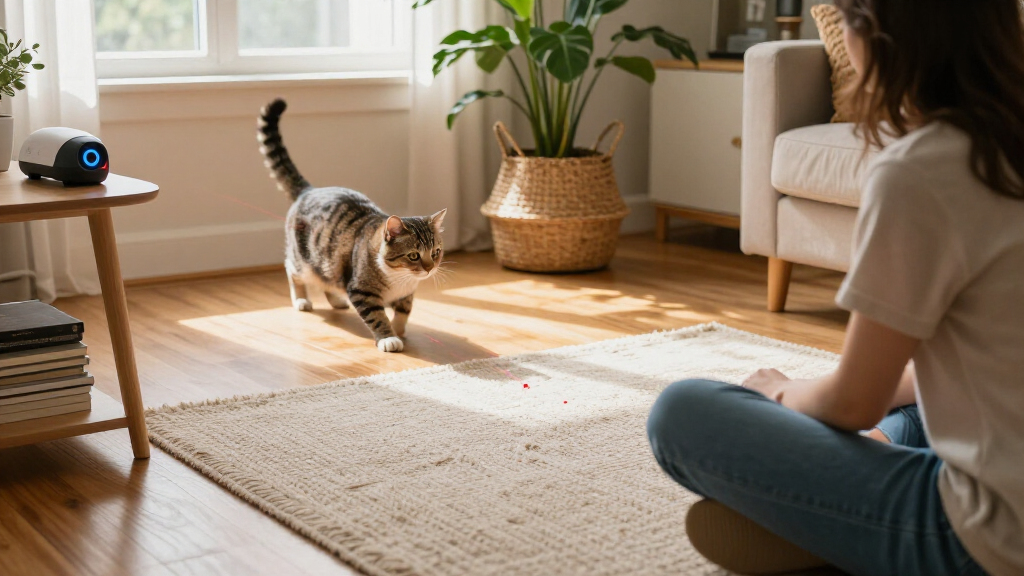

Automatic laser cat toys promise a way to add movement to a cat’s day when a person is busy or away, but they vary in how much control they give you. The practical choice is usually between a timer-based toy that starts and stops on its own and an app-controlled model that lets you schedule or adjust sessions remotely. Timer models suit owners who want simple, occasional play without extra setup; app models suit people who need more control over timing and are comfortable relying on a connected device. In either case, a moving dot is not a substitute for interactive play, and a laser toy should be used with care.

YVE LIFE Automatic Interactive Laser Cat Toy, 4th Gen Motion Activated with Random Trajectory
- ✔ Movement: Random trajectories via dual motors
- ✔ Play session: 15 minutes per motion-triggered session
- ✔ Speed modes: Fast, slow, and mixed
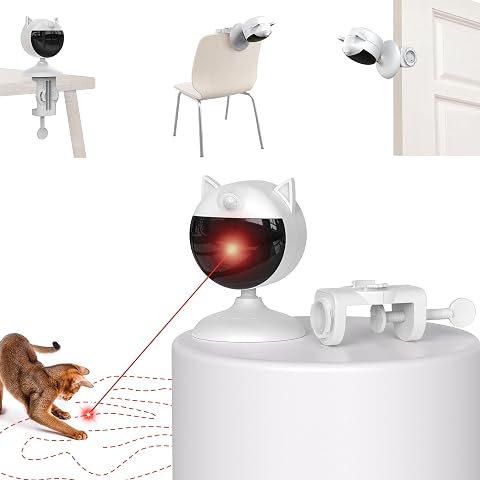
Potaroma Smart Sensor Cat Laser Toys Interactive, Motion Activated Truly Random Trajectory, Clamp Design, Automatic Chargeable Ki…
- ✔ Movement: Truly random trajectory mechanism
- ✔ Modes: Sensing mode and timer mode
- ✔ Sensing session: 5 minutes before standby

TBTeek Cat Toy, Automatic Motion-Activated, 5 Fun Patterns, 4 Speed Modes
- ✔ Projected patterns: Five: smile, mouse, star, butterfly, and red dot
- ✔ Speed modes: Four: slow, medium, quick, and mixed
- ✔ Automatic session: 10 minutes before two-hour sleep mode
At a Glance
| Criteria | Timer-based automatic laser cat toys | App-controlled automatic laser cat toys | Winner |
|---|---|---|---|
| Typical cost and value | Usually the lower-cost choice; value is strongest for basic timed sessions. | Usually costs more; extra value depends on whether remote controls and schedules get used. | A |
| Setup and daily use | Typically set the toy’s position and timer, then let it run its programmed session. | Requires app pairing and may require account, Bluetooth, or Wi-Fi setup, depending on the model. | A |
| Scheduling and control | Controls are usually limited to onboard buttons, modes, and preset timers. | May allow remote starts, schedules, or mode changes; features vary by product. | B |
| Play variation | Often offers a small set of movement patterns or speeds. | Some models offer additional patterns or adjustable settings, but variety is not guaranteed. | Depends |
| Reliability and connectivity | No app or network connection is needed; fewer connected features can mean fewer setup dependencies. | App, phone, or network dependencies can add setup and troubleshooting; basic functions may still work locally, depending on the toy. | A |
| Safety and supervision | Needs careful placement and session limits; the owner must follow the product’s laser guidance. | Remote access does not remove the need to follow laser safety instructions or supervise appropriately. | Tie |
| Best household fit | Best for owners who want occasional automated play with minimal setup. | Best for owners who want to manage sessions away from home or adjust routines more often. | Depends |
YVE LIFE Automatic Interactive Laser Cat Toy, 4th Gen Motion Activated with Random Trajectory
For a household looking for a dependable middle ground, the YVE LIFE 4th Gen combines genuinely random laser paths with straightforward controls. Its dual-motor movement is designed to vary the dot’s route, which can make the chase less predictable than a repeated rotation. We can choose fast, slow, or mixed movement and angle the head toward floor or wall play, giving us more adjustment than the Potaroma’s angle-based speed and range changes.The motion sensor starts a 15-minute session when it detects activity, a useful window for cats that need a little time to notice the toy and warm up. Its main constraint is the two-hour trigger interval: this is designed for intermittent automatic play, not a button-free sequence of sessions whenever a cat returns. TBTeek shares that interval and offers more patterns, but YVE LIFE’s longer specified session and randomized path make it the more balanced choice for varied independent play.Battery use is another practical strength: the rechargeable 1200 mAh unit is listed for up to two days, and it can also run plugged in. The plastic body is not water resistant, and charging requires a 5V/1A USB supply; the supplied guidance cautions against fast charging. We should place it indoors within its recommended height range and treat the laser as a short activity tool, pairing it with toys the cat can catch. Choose it for balanced automation; skip it if we need frequent on-demand activation or a mount that clamps securely to furniture.
Pros:
- Random trajectory is designed to keep the dot’s route less predictable.
- Three speed modes and adjustable head support different play preferences.
- 15-minute motion-activated sessions offer more time than Potaroma’s five-minute bursts.
- Rechargeable battery, plug-in use, and a quiet dual-motor design support flexible placement.
Cons:
- Sensor activation is limited to once every two hours.
- Requires a 5V/1A charger; fast charging may damage the battery.
- Indoor use only and not water resistant.
Best for: Indoor cat owners who want randomized movement, adjustable aiming, and a 15-minute automatic session in one freestanding unit.
Not ideal for: People who want repeated sensor-triggered play throughout the day, or a toy that can be clamped to a narrow perch.
Bottom line: YVE LIFE is our most balanced pick for varied, hands-free indoor play, provided its two-hour sensor interval fits the household routine.
“YVE LIFE is our most balanced pick for varied, hands-free indoor play, provided its two-hour sensor interval fits the household routine.”
Potaroma Smart Sensor Cat Laser Toys Interactive, Motion Activated Truly Random Trajectory, Clamp Design, Automatic Chargeable Ki…
The Potaroma’s defining feature is its dual-clamp design, which lets us attach it to places such as a chair or door. That changes where the toy can work: unlike the freestanding YVE LIFE and TBTeek units, it is less likely to be batted onto the floor during a chase. It is the clearest choice when placement stability matters more than having many preset patterns.Like YVE LIFE, Potaroma describes a truly random trajectory, but its play routine is shorter. In sensing mode it activates for five minutes, then enters standby; if it detects no activity during standby, it powers off. A timer mode is also listed, although the supplied details do not explain its schedule. The laser’s speed and range can be adjusted by changing the tilt angle, which provides a simple physical control, while YVE LIFE offers three explicit speed modes.Battery life is listed as five to ten days under regular play, and the unit supports operation while charging. That makes it a useful option for a chosen, semi-permanent location. The tradeoff is a need to clamp it at least 2.8 feet high as recommended, so it may be awkward in rooms without a suitable attachment point. As with the other laser picks, we should supplement it with catchable toys rather than relying on the moving dot alone. Pick Potaroma for a stable mount and brief automatic bursts; look elsewhere if longer sessions or clearly defined speed presets matter more.
Pros:
- Dual clamps offer more secure placement than the two freestanding alternatives.
- Random movement and tilt adjustment provide trajectory variety.
- Sensing and timer modes give two described ways to run play.
- Listed five-to-ten-day battery runtime and use while charging can reduce interruptions.
Cons:
- Five-minute sensing sessions are shorter than YVE LIFE’s 15-minute sessions and TBTeek’s initial 10-minute run.
- Recommended mounting height of at least 2.8 feet limits placement options.
- Timer mode schedule and battery capacity are not specified in the supplied details.
Best for: Owners who want to secure a laser toy to a door, chair, or other suitable surface and value short motion-triggered play bursts.
Not ideal for: Homes without a safe clamp point, or cats that need longer sessions and clearly labeled speed presets.
Bottom line: Potaroma is the practical choice when a clamp mount solves a real placement problem, though its short sensing sessions make it less suited to extended play.
“Potaroma is the practical choice when a clamp mount solves a real placement problem, though its short sensing sessions make it less suited to extended play.”
TBTeek Cat Toy, Automatic Motion-Activated, 5 Fun Patterns, 4 Speed Modes
TBTeek puts choice at the center of its design: we can select among five projected patterns—smile, mouse, star, butterfly, or red dot—and four speed settings. For cats that lose interest in a single dot shape, that menu offers more visible variety than YVE LIFE’s three speed modes. The tradeoff is that more options do not guarantee a better chase; some cats may respond most to a simple moving point, making the extra patterns less useful.Its motion sensor runs the toy for 10 minutes, then starts a two-hour sleep period. It can activate again after that rest when movement is detected, and the instructions say we can manually restart it during the sleep period. That manual override is a useful distinction from the described YVE LIFE routine, although it also means continued play may require a person to intervene. Potaroma, by comparison, uses five-minute sensing bursts and focuses on clamp mounting rather than selectable patterns.The rechargeable unit is listed for approximately five days of use and charges by USB-C in about two and a half hours. It cannot operate while charging, so we need to plan around recharge time. Its compact footprint may suit a table or shelf, and the recommended placement is 8–35 inches high. The provided product information does not clearly identify a battery capacity or give detailed trajectory mechanics beyond variable rotation. Choose TBTeek for selectable patterns and speeds; consider YVE LIFE if random movement and a longer session are higher priorities, or Potaroma if secure mounting is essential.
Pros:
- Five projected patterns offer more visual choices than the other two picks.
- Four speed modes make it easy to vary pace.
- Manual restart during the two-hour sleep period can extend play when a person is present.
- USB-C charging and a listed runtime of approximately five days.
Cons:
- Runs for 10 minutes before a two-hour sleep period.
- Cannot operate while charging.
- Product details do not specify battery capacity or a motion sensor range.
Best for: Owners of indoor cats who enjoy changing visual patterns and want several speed settings in a compact tabletop toy.
Not ideal for: People who need the toy to work while charging, want a clamp mount, or prefer fewer settings with more detailed movement specifications.
Bottom line: TBTeek makes the most sense for cats that benefit from changing patterns and pace, as long as its charging pause and scheduled rest suit the routine.
“TBTeek makes the most sense for cats that benefit from changing patterns and pace, as long as its charging pause and scheduled rest suit the routine.”
As an Amazon Associate we earn from qualifying purchases.
Key Differences
The strongest difference is control. A timer model is easier to bring into a routine: place it securely, choose an available setting, and let its built-in schedule handle a short session. An app model can be more flexible when an owner wants to start play remotely or change a schedule without touching the toy. That flexibility has value when it solves a real routine problem. If the toy will sit in one place and run the same brief session each day, app control may add little beyond setup work.
Neither type guarantees a better play experience. Movement patterns, speed, noise, stability, and the cat’s response vary by model and by animal. A toy that can move a laser dot unpredictably may attract attention, but cats can become frustrated when they never catch anything. End laser play with a tangible toy or treat where appropriate, and keep sessions short. Buyers should check the specific product’s instructions for safe placement, operating limits, and whether it can be used unattended.
For most households, a basic timer model is the better starting point and the better value. Pay extra for app control when remote access or flexible scheduling solves a recurring need, rather than for connectivity alone. If a cat ignores lasers, has difficulty with fast-moving light, or needs interactive play and reassurance, neither automatic format should be the main solution.
Detailed Comparison
Typical cost and value (Timer-based automatic laser cat toys wins — moderate)
Timer-based models win, with a moderate gap. They generally cost less because they do not need to support app features. The cheaper option is better value for a fixed routine; an app premium makes sense only when remote control or more flexible scheduling will be used regularly.
Setup and daily use (Timer-based automatic laser cat toys wins — moderate)
Timer-based models win, with a moderate gap. Their controls are usually on the toy, so setup is direct and daily use has fewer steps. App models add pairing and software setup, which can be manageable but makes a simple play session depend on more pieces working together.
Scheduling and control (App-controlled automatic laser cat toys wins — major)
App-controlled models win, with a major gap for remote use. Timer models are limited to their onboard settings, while an app can offer remote starts, scheduling, or adjustments, depending on the product. This matters to owners whose schedule changes or who want to manage sessions away from home; it adds little for someone who only needs one local preset.
Play variation (minor difference)
It depends on the specific model, with a minor overall gap between categories. Some app-controlled toys include more adjustable modes, but an app does not guarantee more engaging movement. Compare the actual patterns, speed options, and placement requirements, and consider whether your cat responds to laser play at all.
Reliability and connectivity (Timer-based automatic laser cat toys wins — moderate)
Timer-based models win, with a minor to moderate gap. They do not rely on app pairing or a network for their basic operation. Connected models can still work reliably, but their extra functions may be affected by compatibility or connection problems. Check whether the toy retains its basic schedule if the phone or network is unavailable.
Safety and supervision (minor difference)
Neither category has an inherent advantage; the gap is minor. Both use a laser and require owners to follow the manufacturer’s safety instructions, avoid directing light toward eyes, and place the toy carefully. App access can make remote operation easier, but it does not make unattended use automatically appropriate. Follow the specific model’s guidance.
Best household fit (moderate difference)
The winner depends on the household, with a moderate difference in convenience. A timer toy fits owners who want a simple, predictable session at home. An app model fits owners who benefit from remote changes or varied schedules. Neither replaces interaction with a person, and a cat that does not enjoy laser play may be better served by a different toy.
Timer-based automatic laser cat toys: Pros and Cons
Pros:
- Usually costs less than an app-controlled alternative.
- Simple onboard controls and no app pairing.
- Basic schedules do not depend on a phone or network.
Cons:
- Limited remote access and schedule adjustments.
- Preset modes may offer little variety.
- Still needs careful placement and appropriate session limits.
App-controlled automatic laser cat toys: Pros and Cons
Pros:
- Can offer remote starts, scheduling, or setting changes, depending on the model.
- Useful for routines that vary from day to day.
- May provide extra adjustable play modes on some models.
Cons:
- Usually costs more, and added features may go unused.
- App or network setup can create extra friction.
- Connectivity does not improve safety or guarantee that a cat will enjoy the toy.
Who Should Choose What
Choose Timer-based automatic laser cat toys if:
- You want a lower-cost toy for short, predictable sessions at home.
- You prefer onboard controls and want to avoid app setup.
- You value basic operation that does not depend on phone connectivity.
Choose App-controlled automatic laser cat toys if:
- You regularly need to change or start sessions while away from the toy.
- Your schedule changes enough that remote scheduling would be useful.
- You have checked that the specific app features justify the extra cost for your routine.
Skip both if: Your cat ignores laser toys, becomes frustrated by them, or needs human interaction and enrichment that an automatic light cannot provide.
Value for Money
The timer-based option is the stronger value for most buyers because it covers the core use case—brief, automatic sessions—at a lower likely cost and with less setup. Paying more for an app-controlled model is worthwhile when remote operation or flexible scheduling will solve a real, recurring problem. It is poor value if the toy will run the same preset routine in the same room. Check each model’s listed features, power requirements, app compatibility, and operating guidance before comparing prices; features differ, and a higher price alone does not promise better play.
Final Verdict
Choose a timer-based automatic laser cat toy for a simple, affordable way to add occasional movement to a home routine. Choose an app-controlled model if remote starts or flexible scheduling matter enough to justify its extra cost and setup. The deciding factor is whether you will use that added control: without a genuine need for it, the timer model is the better buy for most households. If your cat does not enjoy laser play or needs more direct interaction, skip both and choose an enrichment option you can share with your cat.
Frequently Asked Questions
Are app-controlled automatic laser cat toys worth paying more for?
They can be, if you will regularly use remote starts, schedule changes, or other controls the particular model offers. For one fixed daily routine, a timer model usually provides better value.
Can I leave an automatic laser toy running while I am away?
Follow the manufacturer’s instructions for the specific toy. Automatic operation does not by itself make unattended use suitable; placement, session limits, and the cat’s response matter.
Do automatic laser toys keep cats from getting frustrated?
Not necessarily. A cat may chase the dot without ever catching anything. Keep sessions short and, where appropriate, finish with a physical toy or treat so play has a tangible endpoint.
Which type is easier to use: timer-based or app-controlled?
Timer-based models are generally simpler because their controls are on the toy and do not require app pairing. App models offer more potential control but add setup steps and may depend on a phone or connection.
What should I compare before buying either type?
Check the available movement patterns, timer options, power source, stability, app compatibility if relevant, and the maker’s laser safety instructions. Also consider whether your cat already responds well to laser play.