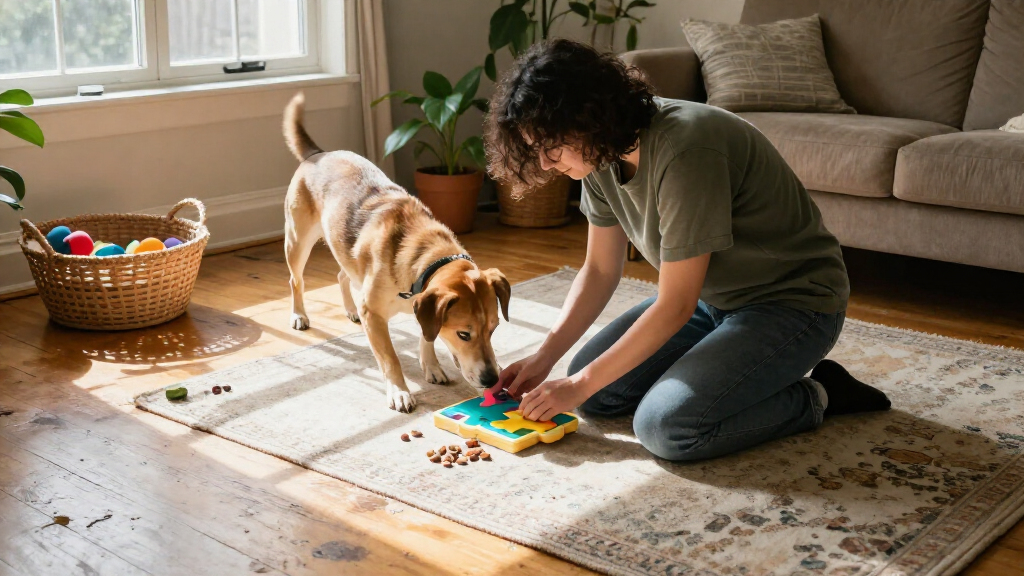

“Interactive dog toys” covers two different ways to occupy a dog: treat-dispensing toys turn eating into a puzzle, while electronic toys move, make sounds, or respond to a dog’s actions. The practical choice is whether your dog is more motivated by food and problem-solving or by chasing and novelty. Treat toys are usually simpler to supervise and easier to adapt to meal routines; electronic toys can prompt more physical play, but they need a dog that enjoys their movement and sound. This comparison focuses on those two categories, since the best fit depends less on a toy’s feature list than on how your dog plays.

Get pet supplies delivered free with Prime
- Fast, free delivery on millions of items
- Prime Video, Amazon Music and more included
- Member-only deals all year

Interactive Dog Ball Toy – Automatic Smart Teasing Ball (Blue)
- ✔ Toy type: Ball
- ✔ Material: Soft TPR rubber
- ✔ Dimensions: 3.98 × 3.98 × 3.98 inches

Upgraded Interactive Squirrel Dog Toy – Jumping, Self-Moving, USB Rechargeable, Indestructible
- ✔ Toy type: Self-moving ball-style toy
- ✔ Movement: Rolling, bouncing, and jumping
- ✔ Sound: Built-in sound effects
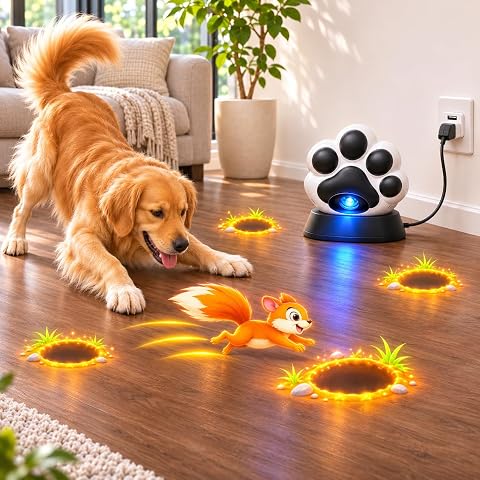
Interactive Pet Projector Toy for Dogs and Cats – USB Powered Floor Light
- ✔ Toy type: Laser pointer
- ✔ Intended pets: Cats and dogs
- ✔ Power: USB powered
At a Glance
| Criteria | Treat-dispensing interactive dog toys | Electronic interactive dog toys | Winner |
|---|---|---|---|
| Engagement style | Food motivation, licking, chewing, and solving a dispensing puzzle | Movement, sound, lights, or responses trigger chase and investigation | Depends |
| Physical activity | Usually modest; most activity comes from nudging, rolling, or chewing | Can prompt more running or chasing in a suitable indoor space | B |
| Mental enrichment | Strong when the toy requires the dog to work out how to release food | Varies by toy; novelty and interaction can stimulate, but may not require much problem-solving | A |
| Supervision | Often manageable nearby, though chewing and frustration still need watching | More likely to need close observation, especially around moving parts, batteries, or small components | A |
| Durability and maintenance | Few moving parts; cleanability and chew resistance depend on the design | Motors, sensors, and batteries add failure points and care requirements | A |
| Cost and value | Often lower-cost and can make part of a meal last longer | Often costs more; value depends on repeated interest and reliable operation | A |
Interactive Dog Ball Toy – Automatic Smart Teasing Ball (Blue)
This is the most balanced choice for buyers looking for a toy that can set a chase in motion without requiring someone to roll a ball by hand. Its motion-sensing direction changes help it react to obstacles, while normal and smart modes offer a way to vary the activity. Compared with the squirrel, it has no described sound effects or bouncing action, but its simpler rolling play may suit dogs that prefer to pursue movement without extra sensory input. The roughly four-inch body also takes less room than the squirrel’s six-inch form, although the listed size recommendation is for large dogs and the compact dimensions could be a poor fit for some of them.The stated up-to-180-minute runtime gives buyers a sense of session capacity, but this remains a rechargeable device rather than a toy that is always ready without planning. Its soft, water-resistant TPR rubber is easier to clean and more adaptable to play surfaces than the squirrel’s non-water-resistant electronic plush exterior. Water resistance does not mean it should be submerged. The built-in lights may also distract some dogs, especially in darker rooms, and the product description does not establish how it performs on every floor or outdoors. We place it first for offering the clearest combination of hands-free movement, mode choice, and manageable size; dogs that prefer tugging, chewing, or human-led games may still ignore it.
Pros:
- Obstacle-responsive rolling creates a chase without someone steering the toy.
- Two modes provide a choice of play behavior.
- Water-resistant TPR rubber is easy to wipe clean.
- USB rechargeable operation avoids disposable batteries.
Cons:
- Requires charging, with play time limited to the stated runtime per charge.
- Its approximate four-inch size may not suit small dogs or some large dogs.
- Built-in lights may be distracting in low-light settings.
Best for: Dogs that enjoy chasing moving objects and households seeking a rechargeable toy with more than one play mode.
Not ideal for: Small dogs, homes with very little clear floor space, or dogs that are bothered by lights or prefer toys they can tug and carry.
Bottom line: We rank this first for adaptable, hands-free chase play, provided its size and lights suit your dog and space.
“We rank this first for adaptable, hands-free chase play, provided its size and lights suit your dog and space.”
Upgraded Interactive Squirrel Dog Toy – Jumping, Self-Moving, USB Rechargeable, Indestructible
Where the teasing ball focuses on rolling pursuit, this squirrel layers jumping, bouncing, and sound effects into its movement. That combination may make it a stronger match for dogs who lose interest when a toy follows one simple motion. At six inches across, it also presents a larger target than the ball, though the listing still cautions that its size may be less satisfying for large breeds. The product’s broad breed-size field should not be taken as a guarantee that the toy will suit every dog.The tradeoff is that its plush exterior and electronic core make it less versatile around water than the TPR ball. It is explicitly not water-resistant, so wet yards, muddy paws, and washing under running water are poor fits. The description calls it durable and indestructible, but an ABS core inside plush does not establish that it will withstand determined chewing; we would choose it for interactive movement, not as a chew toy. It is rechargeable, which avoids disposable batteries, but buyers should expect to manage charging. Compared with the projector, it creates a moving target a dog can follow around the room; compared with the teasing ball, it offers more sensory variety but less confidence for damp environments and potentially more stimulation for sound-sensitive dogs.
Pros:
- Rolling, bouncing, and jumping action offers varied movement.
- Sound effects add another cue during play.
- USB rechargeable power eliminates disposable batteries.
- Six-inch size is larger than the automatic teasing ball.
Cons:
- Not water-resistant, restricting play to dry conditions.
- Electronic plush construction should not be treated as chew-proof.
- The size may still be unsatisfying for some large dogs.
Best for: Indoor dogs that enjoy moving targets and respond to sound as well as bouncing or rolling motion.
Not ideal for: Dogs that chew through plush toys, are sensitive to sound, play in wet areas, or need a particularly large target.
Bottom line: We recommend the squirrel over the simpler ball when movement variety and sound matter more than wet-weather flexibility.
“We recommend the squirrel over the simpler ball when movement variety and sound matter more than wet-weather flexibility.”
Interactive Pet Projector Toy for Dogs and Cats – USB Powered Floor Light
This projector takes a different route from the two rolling toys: it casts colorful animal-inspired images and glowing targets to invite a dog to look, follow, and move around indoors. Its multiple projection patterns offer visual variation without a ball crossing the room, and the four-inch paw-shaped unit is easy to fit into a small space. That makes it a useful alternative when a household wants a brief indoor activity but does not have room for the teasing ball’s chase or the squirrel’s bouncing movement.The key limitation is that this is a supervised visual activity, not a self-propelled toy a dog can nose, chase independently, or carry. The listed toy type is laser pointer, so we would keep sessions controlled and follow the product’s safety guidance rather than leave it running unattended. Unlike the rechargeable ball and squirrel, it is USB powered, which means its placement depends on access to a suitable power source. It is also limited to indoor use, whereas the teasing ball is described for indoor and outdoor play. Dogs who engage most with sound, touch, or physical objects may find the projector less satisfying; in that case, the squirrel or ball offers a more direct moving target. We rank it third because it fills a compact visual niche, but offers narrower interaction.
Pros:
- Multiple projection patterns add visual variation.
- Compact paw-shaped design fits small indoor spaces.
- USB power avoids disposable batteries.
- Can encourage indoor movement when outdoor play is limited.
Cons:
- Requires supervision during use.
- Limited to indoor settings with USB power access.
- Provides visual stimulation rather than a physical toy to chase and handle.
Best for: Owners seeking a small, USB-powered visual activity for supervised indoor sessions, especially when floor space is limited.
Not ideal for: Dogs that need hands-on chase, chewing, or carrying play, or households looking for an outdoor or unattended toy.
Bottom line: We choose the projector for compact, supervised visual play, while dogs seeking physical interaction are better served by either moving toy.
“We choose the projector for compact, supervised visual play, while dogs seeking physical interaction are better served by either moving toy.”
As an Amazon Associate we earn from qualifying purchases.
Key Differences
The clearest distinction is what starts the play. A food toy lets a dog act on a reward it can smell and often eat, which can sustain attention through repeated effort. An electronic toy supplies movement or sensory novelty. That can be more exciting for a dog that likes to chase, but the appeal may fade if the toy’s motion is predictable or the dog is unsure about noise.
For everyday enrichment, treat-dispensing designs are generally the more practical starting point. They tend to be simpler, can slow down a meal, and often ask the dog to manipulate an object rather than merely follow it. Electronic toys have an advantage when the goal is to encourage movement, but they bring more maintenance and supervision considerations. Neither category replaces walks, training, or interaction with people.
Value follows fit. Paying extra for electronics makes sense when your dog reliably enjoys the toy and uses it safely. If food is the stronger motivator, a well-sized, washable treat toy is often a better purchase. A dog that guards food, swallows objects, or becomes distressed by moving toys may need a different form of enrichment altogether.
Detailed Comparison
Engagement style (moderate difference)
Treat toys reward repeated actions with food, which can keep a food-motivated dog focused. Electronic toys attract attention through motion, sound, or response, which suits dogs that investigate or chase. Neither style is universally more engaging; the dog’s motivation decides the winner. The gap is moderate because a mismatch can mean the toy gets ignored.
Physical activity (Electronic interactive dog toys wins — moderate)
Electronic toys win by a moderate margin when they prompt safe chasing or movement. Treat toys usually involve more stationary nudging, licking, or chewing, although rolling dispensers can get a dog moving around. For an indoor activity boost, B has the clearer advantage, but it does not replace outdoor exercise.
Mental enrichment (Treat-dispensing interactive dog toys wins — moderate)
Treat-dispensing toys usually win by a moderate margin when they require a dog to roll, paw, or manipulate the toy to release food. Some electronic toys respond to actions and can invite exploration, but others mainly move for the dog to chase. Choose a difficulty that allows success; a puzzle that is too hard can lead to frustration rather than useful challenge.
Supervision (Treat-dispensing interactive dog toys wins — moderate)
Treat toys have a minor-to-moderate advantage because many have no electronics or powered moving parts. Still, dogs that chew aggressively can damage them, and loose pieces or unsuitable sizing create hazards. Electronic toys may need closer observation for chewing, battery access, or entanglement with moving parts. Follow the manufacturer’s guidance for either type and remove damaged toys.
Durability and maintenance (Treat-dispensing interactive dog toys wins — moderate)
Treat toys generally win by a moderate margin on simplicity: there are no motors or sensors to stop working, though food residue calls for regular cleaning and material strength varies. Electronic toys add batteries, charging, and mechanical parts that may need care or fail. A sturdy electronic model can still be worthwhile if the dog uses it often and it is easy to maintain.
Cost and value (Treat-dispensing interactive dog toys wins — moderate)
Treat toys are often the better value for routine use, particularly when they work with a portion of the dog’s regular food rather than extra treats. Electronic toys can justify a higher price if they deliver repeatable, safe play that a dog cannot get from simpler options. The difference is moderate: a cheaper toy that sits unused is poor value in either category.
Treat-dispensing interactive dog toys: Pros and Cons
Pros:
- Uses food motivation to encourage sustained problem-solving.
- Can make meals or snacks last longer.
- Usually has fewer mechanical parts and is often less expensive.
Cons:
- Offers limited exercise compared with chase-oriented play.
- Requires cleaning and appropriate food portions.
- May be a poor fit for dogs that guard food or chew through toys.
Electronic interactive dog toys: Pros and Cons
Pros:
- Can encourage movement and chase play indoors.
- Provides novelty for dogs drawn to motion, sound, or responsive toys.
- May offer play without making food the reward.
Cons:
- Moving parts and batteries add maintenance and supervision needs.
- Some dogs may be startled by noise or lose interest in repetitive motion.
- Higher cost may not pay off if the dog rarely uses it.
Who Should Choose What
Choose Treat-dispensing interactive dog toys if:
- Your dog is strongly food-motivated and enjoys working for treats or kibble.
- You want to add a puzzle or slow down a meal with a simple toy.
- You prefer a lower-cost option with fewer powered parts.
Choose Electronic interactive dog toys if:
- Your dog enjoys chasing moving objects and is comfortable with the toy’s sound and motion.
- You want to encourage short bursts of indoor activity.
- You are prepared to supervise play and maintain batteries or moving components.
Skip both if: Neither may suit a dog that guards food, destroys or swallows toy parts, or becomes anxious around moving objects. Ask a veterinarian or qualified trainer for safer enrichment ideas tailored to your dog.
Value for Money
Treat-dispensing toys are usually the stronger value for a first purchase: they often cost less, can support a meal routine, and offer a clear task for food-motivated dogs. Use part of the dog’s usual daily food allowance where appropriate to avoid adding excess calories. Paying more for an electronic toy is worthwhile when your dog repeatedly chooses it, plays safely, and benefits from the movement it encourages. If interest lasts only a few sessions, the extra features have not earned their price.
Final Verdict
For most owners choosing a first interactive toy, start with a suitably sized treat-dispensing design. It offers a direct form of enrichment, is often easier to maintain, and tends to cost less. Choose an electronic toy when your dog clearly likes chasing motion and you want a supervised way to prompt indoor activity. The deciding factor is your dog’s play motivation: food and problem-solving favor A; movement and novelty favor B. Skip both categories if your dog cannot use them safely or shows distress.
Frequently Asked Questions
Are treat-dispensing toys better than electronic dog toys?
They are a better starting point for many food-motivated dogs because they combine a reward with a task and often cost less. Electronic toys are a better fit for dogs that enjoy movement and chase play. Choose by your dog’s response, not by the number of features.
Can an electronic toy replace a walk?
No. It may add short bursts of indoor activity, but it does not provide the same range of movement, smells, and experiences as a walk. Treat it as one part of a broader exercise and enrichment routine.
How do I choose a safe interactive toy?
Match the toy’s size and construction to your dog’s body and chewing habits. Read the maker’s use instructions, supervise initial play, and remove the toy if it cracks, sheds pieces, or exposes a battery or mechanism. For treat toys, use suitable food portions and clean the toy regularly.
Is an expensive interactive toy worth buying?
Pay more when the extra features suit your dog and the toy gets regular, safe use. For a food-motivated dog, a simple treat toy may deliver more value. For a dog that repeatedly chases responsive movement, an electronic model may earn its higher cost.