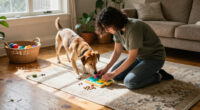
Choose a safe interactive dog toy, set it up for your dog, and teach your dog how to use it. This beginner guide is for dog owners selecting a first puzzle, food-dispensing, or treat-search toy. Plan about 20-30 minutes for choosing a toy and supervising the first session; later sessions may take less setup time.

Get pet supplies delivered free with Prime
- Fast, free delivery on millions of items
- Prime Video, Amazon Music and more included
- Member-only deals all year

Interactive Dog Ball Toy – Automatic Smart Teasing Ball (Blue)
- ✔ Toy type: Ball
- ✔ Material: Soft TPR rubber
- ✔ Dimensions: 3.98 × 3.98 × 3.98 inches

Upgraded Interactive Squirrel Dog Toy – Jumping, Self-Moving, USB Rechargeable, Indestructible
- ✔ Toy type: Self-moving ball toy
- ✔ Materials: Plush exterior, ABS plastic, electronic components
- ✔ Dimensions: 6 × 6 × 6 inches
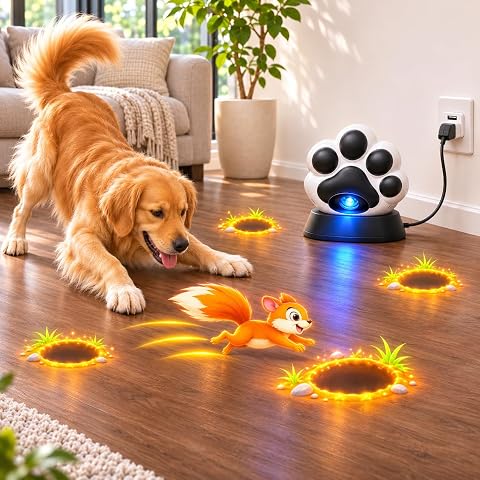
Interactive Pet Projector Toy for Dogs and Cats – USB Powered Floor Light
- ✔ Toy type: Laser pointer / floor projector
- ✔ Recommended pets: Cats and dogs
- ✔ Power source: USB
Difficulty: Beginner | Time: 20-30 minutes for selection and first supervised session
What You’ll Need
Tools & Materials:
- Your dog’s current weight and approximate muzzle size
- A clean, intact interactive dog toy sized for your dog
- Dog food or treats that fit the toy and suit your dog’s diet
- A towel or washable mat for food play
Knowledge:
- How your dog typically chews and responds to new objects
- Any food allergies, diet restrictions, or choking risks relevant to your dog
Read the toy maker’s age, size, cleaning, and supervision guidance before use. If your dog has a history of swallowing objects, damaging toys, or guarding food, ask your veterinarian or a qualified reward-based trainer for guidance before offering a food toy.
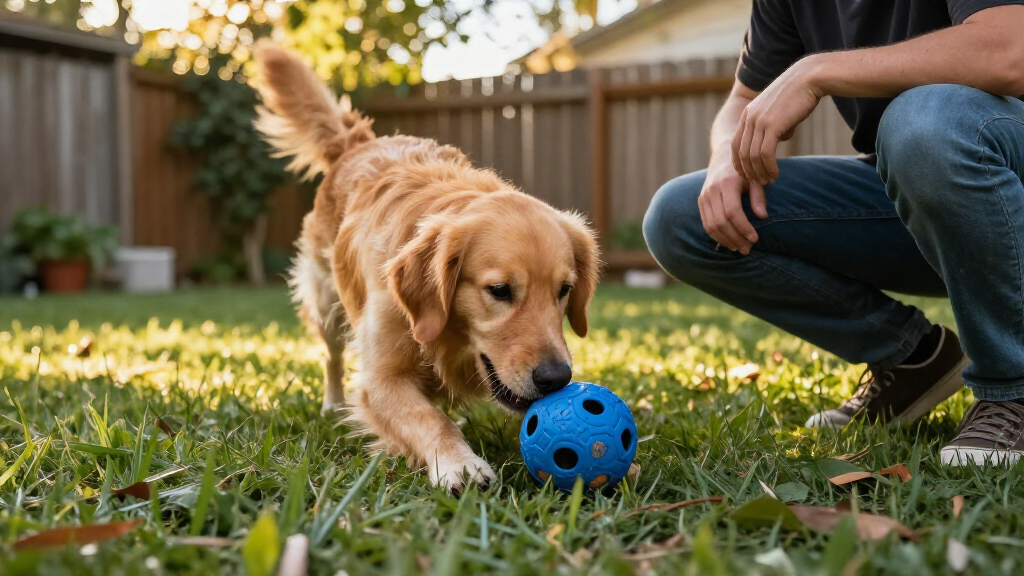
Interactive Dog Ball Toy – Automatic Smart Teasing Ball (Blue)
For a buyer who wants a toy that can keep a dog moving with less direct participation, this automatic teasing ball is the most adaptable pick in the group. Its motion sensors change direction around obstacles, giving a chasing dog a less predictable target than the projector’s stationary light patterns. Two modes add a simple way to vary the play, and the stated runtime of up to 180 minutes per charge can support multiple sessions before recharging.The soft, water-resistant TPR rubber also makes this model more practical for cleanup and mixed indoor or outdoor play than the squirrel, which is explicitly not water-resistant. Still, the ball is only about four inches across, and the listing recommends it for large dogs. That mismatch in the supplied size guidance means buyers should consider their dog’s mouth and play style rather than assuming the label fits every dog. In a cramped room, its rolling action may also be less useful than a toy designed for closely supervised, stationary visual play. Choose it for a dog who enjoys chasing unpredictable movement; skip it if you need a plush or sound-based toy, or if charging is inconvenient.
Pros:
- Obstacle response makes the ball’s path less predictable during chase play.
- Two modes offer a choice of play behavior.
- Water-resistant TPR rubber is easy to clean and supports indoor or outdoor use.
- Up to 180 minutes of stated play per charge reduces the need for frequent charging.
Cons:
- Requires charging, and the runtime is limited to up to 180 minutes per charge.
- At about four inches wide, it may not suit small dogs or tight indoor spaces despite the large-dog recommendation.
- Built-in lights may distract some dogs in low-light settings.
Best for: Dogs that enjoy chasing a moving target and owners who want two modes, obstacle response, and a water-resistant surface.
Not ideal for: Small dogs with a poor fit for a nearly four-inch ball, homes with very limited floor space, or buyers who want sound effects or visual projection.
Bottom line: We rank this first for its combination of varied movement, two modes, and a water-resistant build, provided its size suits your dog.
“We rank this first for its combination of varied movement, two modes, and a water-resistant build, provided its size suits your dog.”
Upgraded Interactive Squirrel Dog Toy – Jumping, Self-Moving, USB Rechargeable, Indestructible
When a dog loses interest in a simple rolling ball, the self-moving squirrel offers more kinds of activity in one toy. It rolls and bounces, and its sound effects add an auditory cue that the smart teasing ball and projector do not provide. That mix makes it the strongest match here for dogs drawn to unpredictable movement and sound, and the six-inch body gives them a larger target than the roughly four-inch ball.That added stimulation comes with a narrower setting. The squirrel is not water-resistant, so wet grass, damp play areas, and easy hose-down cleanup are out. Its plush exterior and ABS core are described as durable, but the supplied details do not establish that it is indestructible; dogs that chew or tear toys should be supervised and the toy inspected. Compared with the smart ball, it trades a water-resistant surface and a stated runtime for bounce and sound. Compared with the projector, it provides physical movement a dog can chase, but it is bulkier and depends on charging. Pick it when variety is the priority and play stays dry.
Pros:
- Rolling and bouncing create varied movement for chase play.
- Sound effects add stimulation beyond the smart ball’s motion and the projector’s visual patterns.
- USB-rechargeable power avoids disposable batteries.
- Six-inch dimensions provide a larger play target than the smart ball.
Cons:
- Not water-resistant, limiting play to dry settings.
- Its six-inch size may still be less satisfying for some large-breed dogs.
- Electronic components and plush construction may not suit unsupervised chewing.
Best for: Dogs who respond to rolling and bouncing movement plus sound, especially when a larger target is preferable to the smart ball.
Not ideal for: Dogs who play outdoors in wet conditions, determined chewers, or owners seeking a water-resistant toy with a stated runtime.
Bottom line: We recommend the squirrel for dogs who need motion and sound together, as long as play stays dry and chewing is monitored.
“We recommend the squirrel for dogs who need motion and sound together, as long as play stays dry and chewing is monitored.”
Interactive Pet Projector Toy for Dogs and Cats – USB Powered Floor Light
The projector takes a different approach from the two rolling toys: it creates colorful animal-inspired images and glowing targets for a pet to watch and follow. Selectable projection patterns can change the visual scene, making this a compact choice for indoor activity when a dog cannot get outside. It also works for cats, which gives it a broader stated audience than the dog-focused squirrel.Its distinction is also its main limitation. A projected target does not offer the physical chase-and-carry interaction of the smart ball or the squirrel’s bouncing movement, and the product description calls for supervised use. It also needs a USB power source and is limited to indoor environments, whereas the water-resistant smart ball has the more flexible stated setting. The four-inch paw-shaped unit is easy to place, but buyers should treat it as a visual play aid rather than a substitute for a durable ball or a toy for unsupervised play. It makes the most sense for a home with a suitable floor area, a nearby USB connection, and an owner who can stay involved.
Pros:
- Multiple projection patterns offer visual variety.
- USB-powered design avoids disposable batteries.
- Compact four-inch paw-shaped footprint is easy to place.
- Provides an indoor activity option when outdoor play is limited.
Cons:
- Requires supervision during use.
- Limited to indoor settings with access to USB power.
- Visual projection does not provide the physical rolling and bouncing of the other two picks.
Best for: Owners looking for a compact, supervised indoor option that encourages visual tracking, including in homes with both dogs and cats.
Not ideal for: Dogs who need a physical toy to chase and carry, outdoor play, or households that cannot provide supervision and USB access.
Bottom line: We see this as a focused indoor visual-play option for supervised sessions, rather than the most versatile choice for active chasing.
“We see this as a focused indoor visual-play option for supervised sessions, rather than the most versatile choice for active chasing.”
As an Amazon Associate we earn from qualifying purchases.
Before You Start
Inspect the toy and remove packaging, tags, and loose parts. Do not use a toy with cracks, sharp edges, loose seams, or pieces small enough for your dog to swallow. Start with a simple activity and a small portion of your dog’s regular food. Supervise the first sessions, and stop play if the toy breaks or your dog chews off material.
Step-by-Step Instructions
Step 1: Choose a toy that fits your dog
Match the toy to your dog’s size, chewing strength, and play style. Pick a toy too large to swallow and without parts your dog can pull off. For a first puzzle, choose a simple design with food visible or easy to reach. Check the manufacturer’s size and use guidance; a toy labeled for a weight range still needs to suit your individual dog.
Tip: A soft plush toy may suit a gentle search game, while a determined chewer may need a purpose-made durable design. No toy is indestructible.
Check: Your dog can nose or paw the toy without putting the whole toy in its mouth, and its parts remain firmly attached.
Step 2: Prepare a safe play area
Set the toy on a flat, non-slip surface where your dog has room to work. Move cords, small objects, and other pets out of the immediate play area. Place a towel or washable mat beneath food-dispensing toys to catch crumbs and make cleanup easier.
Tip: Use a quiet area for a dog that gets distracted or excited around other pets. Give each dog a separate toy and space if they play at the same time.
Check: The toy sits securely, and your dog can investigate it without bumping into hazards or competing for food.
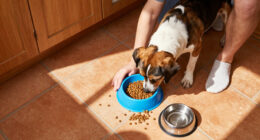
Step 3: Load a small amount of food
Use a few pieces of your dog’s regular kibble or a small amount of a familiar treat. Follow the toy’s instructions for filling, and keep pieces small enough to pass through its openings without forcing them. Count the food as part of your dog’s daily allowance, especially if you use the toy often.
Tip: Avoid ingredients your dog cannot eat. Do not use sticky spreads or hard-to-remove food unless the toy is designed for them and you can clean it fully.
Check: The food stays in place until your dog interacts with the toy, and it can come out without excessive shaking or force.
Step 4: Show your dog how the toy works
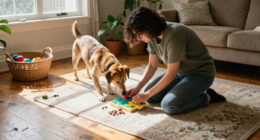
Place the loaded toy near your dog and let it sniff. If needed, roll or tap the toy gently so a piece of food appears, then let your dog eat it. Keep the first challenge easy: leave some food exposed or use a toy setting that releases food with a light nose nudge or paw touch.
Tip: Let your dog discover the reward. Avoid holding the toy in its face or repeatedly moving it if that causes worry or frustration.
Check: Your dog shows interest, interacts with the toy, and gets at least one reward without becoming distressed.
Step 5: Supervise the first play session
Stay nearby while your dog works on the toy. Watch whether it nudges, paws, licks, or chews the toy, and check that the toy stays intact. End the session when the food is gone or your dog loses interest. Take the toy away calmly if your dog begins tearing, biting off pieces, or guarding it.
Tip: Keep early sessions short. A dog that is new to puzzles may benefit from a few minutes of easy success rather than a long, difficult session.
Check: Your dog finishes or stops calmly, and the toy has no missing pieces, cracks, or other damage.
Step 6: Adjust the challenge gradually
After your dog solves the easy version comfortably, add only one small challenge at a time. For example, cover one food opening, use a slightly harder toy setting, or put food in a new compartment. Watch your dog’s response before making another change. If it cannot get a reward after a few tries or starts biting the toy hard, return to an easier setup.
Tip: The goal is focused, enjoyable activity, not the longest possible time to finish.
Check: Your dog keeps trying with relaxed body language and can still earn rewards without damaging the toy.
Step 7: Clean and store the toy
Remove leftover food after play. Wash the toy as its label directs, paying attention to crevices where food can stick, then dry it fully before storage. Keep the toy out of reach between sessions if your dog chews toys when unsupervised.
Tip: Do not put a toy in a dishwasher, freezer, or microwave unless the manufacturer says it is safe for that use.
Check: The toy is clean, dry, and intact, with no food residue or odor left in hidden openings.
Common Mistakes to Avoid
- Starting with a puzzle that is too difficult. — Begin with food partly visible and a simple release. Increase difficulty only after your dog succeeds comfortably.
- Choosing a toy based only on its advertised size or toughness. — Consider your dog’s actual chewing habits, inspect the toy before each use, and supervise play.
- Adding too much food or unfamiliar ingredients. — Start with a small portion of familiar food, account for it in the daily ration, and follow dietary advice from your veterinarian.
- Leaving a food toy with a dog that is chewing or guarding it. — Watch the first sessions. End play if your dog damages the toy or becomes tense around people or other pets.
Troubleshooting
Problem: Your dog ignores the toy.
Solution:
Make the reward easier to see and smell, use a familiar food, and set the toy in a quiet area. Let your dog approach at its own pace. If it remains uninterested, try a different activity such as a supervised treat search.
Problem: Your dog becomes frustrated or barks at the toy.
Solution:
Pause the session and make the next attempt easier. Leave food exposed or show one gentle movement that releases a piece. Stop if your dog remains upset; try again later with a simpler activity.
Problem: Food will not come out.
Solution:
Check that the food size and toy setting match the maker’s instructions. Remove pieces that are jammed, then use smaller kibble or fewer pieces. Do not cut, pry, or modify the toy to widen an opening.
Problem: The toy is damaged or your dog swallows a piece.
Solution:
Take the toy away and discard it if it is cracked, torn, or missing material. Contact your veterinarian promptly if your dog may have swallowed a piece, especially if it chokes, vomits, seems painful, or has trouble passing stool.
What Success Looks Like
The toy fits your dog, remains intact, and provides a reward your dog can reach at an appropriate difficulty. Your dog interacts willingly, stays calm, and finishes or leaves the activity without chewing off parts or showing distress. The toy is clean and dry after use.
Next Steps
Offer the toy during a supervised session when your dog is settled, and rotate it with other safe activities to keep interest. Inspect it before every use and replace it if damaged. If your dog repeatedly guards food, swallows toy pieces, or becomes distressed, stop using the toy and ask your veterinarian or a qualified reward-based trainer for help.
Frequently Asked Questions
How long should my dog use an interactive toy?
Start with a short supervised session and end when the food is gone or your dog loses interest. The right length depends on the toy and your dog; stop sooner if your dog becomes frustrated or starts damaging it.
Can I leave my dog alone with a food puzzle?
Supervise initial sessions and follow the manufacturer’s guidance. Do not leave your dog alone with a toy it chews apart, guards, or may swallow. Remove it after use if unsupervised chewing is a concern.
Should I use treats or my dog’s regular food?
Regular kibble is a practical starting choice if it fits the toy. Treats can also work when they suit your dog’s diet. Count either toward the daily food allowance and avoid ingredients that cause a reaction or conflict with veterinary advice.
What should I do if my dog only chews the toy?
End the session if chewing risks damage. Try a sturdier toy suited to your dog’s chewing style or a simple supervised search game. Do not use a puzzle that your dog repeatedly bites apart.