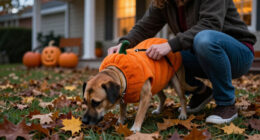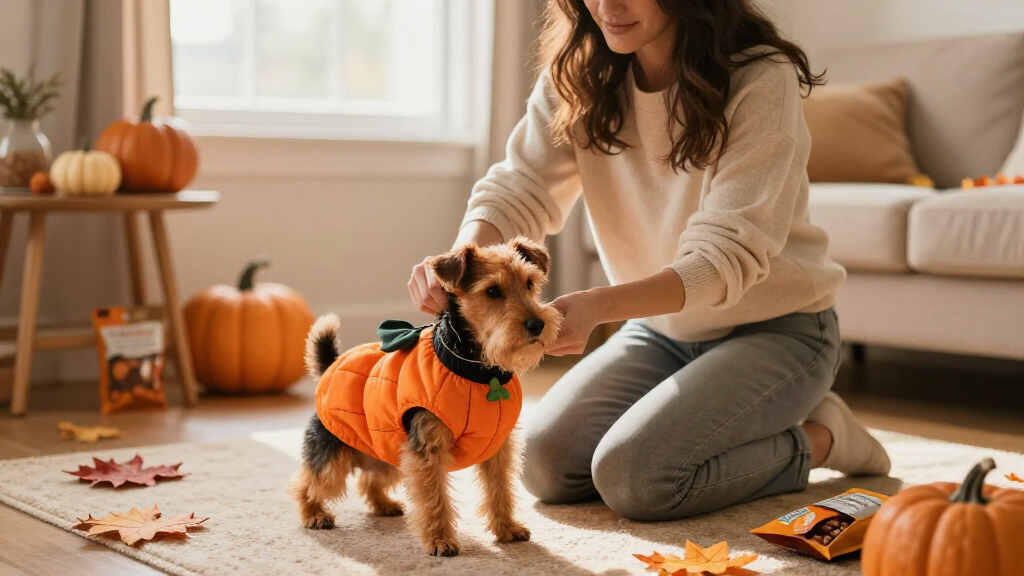

This guide shows you how to put a Halloween costume on your dog safely and with minimal stress — for both of you. You will learn how to measure your dog, choose a costume that fits properly, get your dog used to wearing it through short practice sessions, and spot the warning signs that mean the costume needs to come off immediately. The guide is written for first-time costumers and occasional dog owners; no special training skills are required, just patience and a handful of treats. Expect the full process to take 30-60 minutes on the day itself, plus a few 5-minute practice sessions during the week before Halloween if your dog has never worn clothing. By the end, your dog will be wearing a costume that fits well, moves freely, and can be worn comfortably for photos, a short outing, or a party — and you will know exactly when and how to remove it.

Get pet supplies delivered free — and shop member deals
- Fast, free delivery on millions of items
- Access to Prime Big Deal Days deals on October 6–7
- Prime Video, Amazon Music and more included

SCENEREAL Dog Halloween Costume Onesie with Glow-in-the-Dark Removable Bat Wings
- ✔ Brand: SCENEREAL
- ✔ Material: Polyester velour
- ✔ Sizes: S/M, M, L (back lengths 14–20 inches)

INROAN Small Hero Cape Costume for Dogs & Cats, Red
- ✔ Brand: INROAN
- ✔ Material: Polyester blend
- ✔ Size: Small (back length 13.8 inches)
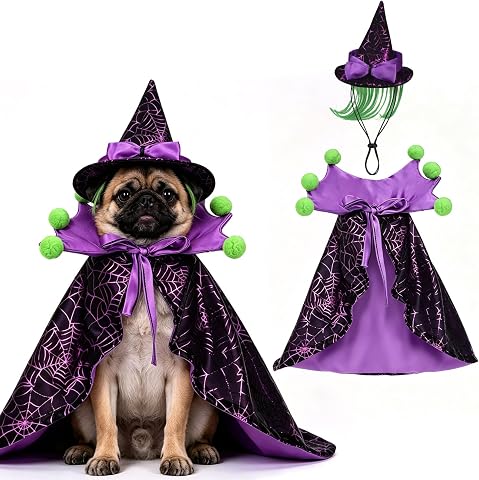
EXPAWLORER Halloween Witch Costume for Cats & Small/Medium Dogs
- ✔ Brand: EXPAWLORER
- ✔ Material: Polyester (foil-printed brocade, satin, pom-poms)
- ✔ Pet Type: Cat, Dog
Difficulty: Beginner | Time: 30-60 minutes (plus several short practice sessions in the days before Halloween)
What You’ll Need
Tools & Materials:
- A soft fabric measuring tape (or a piece of string plus a ruler)
- Small, high-value treats (cheese, chicken, or training treats)
- The costume itself (purchased or homemade)
- A quiet room with non-slip flooring for dressing and practice
- A helper (optional but useful for wriggly dogs)
- Scissors for trimming loose threads or straps (if needed)
Knowledge:
- Basic handling of your dog — being able to gently hold and position them
- Knowing your dog’s typical reactions to new objects and handling
If you have not bought a costume yet, do the measuring step first and write the measurements down. Sizes vary wildly between brands, so always buy against the manufacturer’s size chart rather than a generic ‘large’ or ‘small’ label. If your dog has never worn anything — not even a harness or coat — plan for at least 3-4 short practice sessions before Halloween night rather than dressing them for the first time at the party.
SCENEREAL Dog Halloween Costume Onesie with Glow-in-the-Dark Removable Bat Wings
This onesie earns our top spot because it solves the two biggest problems with dog costumes: dogs pulling them off, and owners never using them again. The stretchy velour fabric moves with your dog rather than against them, and the ribbed cuffs and elastic hem create a snug fit that’s harder to shake loose than a loose cape. Once the detachable wings come off, you’re left with a warm black onesie that’s genuinely useful on chilly autumn walks well past Halloween.Compared with the EXPAWLORER Witch Costume, the SCENEREAL offers a much wider size range — three sizes covering small through large breeds — while the witch set leans on adjustable neck sizing for a narrower slice of pets. The glow-in-the-dark bat wings are the standout party trick here, and because they attach and detach, you control how dressed-up your dog gets. The leash hole is a thoughtful touch the other two costumes lack, making this the safest pick for actual trick-or-treating in the dark.The tradeoffs are real, though. It’s hand wash only with the wings removed, which is more effort than tossing the machine-washable witch cloak in a cycle. And the full-body coverage that makes it secure also means it’s the wrong choice for dogs who overheat easily or firmly refuse full-body clothing — for those pets, the minimal INROAN Hero Cape is the better call.
Pros:
- Ultra-soft, stretchy velour keeps pets warm without restricting movement
- Detachable glow-in-the-dark bat wings let you dial the costume up or down
- Snug elastic hem and ribbed cuffs stay in place on active dogs
- Doubles as everyday winter pajamas after Halloween
- Leash hole makes it practical for evening walks
Cons:
- Hand wash only, and wings must be removed before washing
- Not water resistant, so rain and mud are off-limits
- Full-body design won’t suit dogs who dislike being dressed
Best for: Dogs who tolerate clothing well and owners who want a costume with year-round use as warm pajamas
Not ideal for: Dogs who overheat easily, hate full-body coverage, or frequently play outdoors in wet conditions
Bottom line: The most complete package here: comfortable, secure, versatile, and sized for nearly every dog — as long as you’re willing to hand wash it.
“The most complete package here: comfortable, secure, versatile, and sized for nearly every dog — as long as you’re willing to hand wash it.”
INROAN Small Hero Cape Costume for Dogs & Cats, Red
Some dogs treat costumes like personal insults. For them, the INROAN Hero Cape is the path of least resistance: it drapes over the back, ties at the neck and belly, and leaves the legs, chest, and face completely free. Compared with the SCENEREAL Onesie, there’s simply far less costume to reject, and the lightweight, breathable polyester means overheating is rarely a concern even during an active Halloween party.The personalizable yellow diamond is what lifts this cape above generic superhero capes — adding your pet’s name turns a basic costume into a keepsake and makes for better photos. The adjustable ties also mean a more forgiving fit than the witch costume’s neck-measurement-dependent sizing, and unlike the other two picks, this one explicitly fits cats as well as dogs, so multi-pet households can coordinate.The limitations are straightforward. It’s only available in one small size, so medium and large dogs are out of luck — a direct contrast with the onesie’s three-size range. And because it’s a single layer with no sleeves or coverage, it offers no warmth, making it a poor choice for cold-weather trick-or-treating where the velour onesie shines. It’s also a subtler look; if you want maximum Halloween drama, the witch set delivers more.
Pros:
- Minimal design that even costume-resistant pets tend to accept
- Personalizable name patch on the yellow diamond
- Adjustable neck and belly ties for a secure, forgiving fit
- Lightweight, breathable fabric prevents overheating
Cons:
- Single small size only — no options for larger dogs
- Provides no warmth for cold-weather outings
- A simpler, less dramatic look than full costumes
Best for: Small dogs and cats who pull off anything bulkier than a simple cape
Not ideal for: Medium or large dogs, or owners wanting a warm, full-costume look
Bottom line: The easiest Halloween win for small pets who hate being dressed — just don’t expect warmth or a bold costume statement.
“The easiest Halloween win for small pets who hate being dressed — just don’t expect warmth or a bold costume statement.”
EXPAWLORER Halloween Witch Costume for Cats & Small/Medium Dogs
If the goal is one show-stopping photo for the family Halloween card, the EXPAWLORER Witch Costume is the pick. The two-piece set — a black-purple brocade cloak with 3D green poms and a matching witch hat with green wigs and a bow tie — is the most traditionally festive option here, and the foil-printed fabrics catch light in photos in a way flat polyester capes don’t.In terms of practicality, it sits between the other two picks. It’s machine washable, which beats the hand-wash-only onesie, and its elastic front-leg straps with a neck tie go on faster than tying a cape. The adjustable hat buckle helps keep the hat in place — historically the hardest part of any witch costume. However, the sizing depends heavily on accurate neck measurement, spanning a wide range per size, so a sloppy measurement easily results in a cloak that gaps or binds. The INROAN cape’s tie closure is more forgiving in this respect.The hat itself is the gamble. Some pets ignore it; many will shake it off within minutes, at which point you own a cloak with no hat. Compared with the SCENEREAL onesie, this costume also has less utility beyond Halloween — nobody wears a witch cloak in November. It’s the best-looking option here, but the least versatile.
Pros:
- Complete two-piece look with matching cloak and witch hat
- Machine washable — easier care than hand-wash-only options
- Elastic front-leg straps and adjustable hat buckle for a secure fit
- Works for both cats and small-to-medium dogs
Cons:
- Requires careful neck measurement before ordering
- The hat may not stay on pets who dislike headwear
- Little practical use outside the Halloween season
Best for: Pet owners prioritizing a classic, photogenic Halloween look for parties and photo shoots
Not ideal for: Pets who won’t tolerate a hat, or anyone wanting everyday post-Halloween use
Bottom line: The most photogenic costume of the three, provided your pet keeps the hat on and you measure before buying.
“The most photogenic costume of the three, provided your pet keeps the hat on and you measure before buying.”
As an Amazon Associate we earn from qualifying purchases.
Before You Start
Safety limits come before looks. No costume is worth a stressed or injured dog. Before you begin, commit to three hard rules. First, the costume must never cover the dog’s eyes, ears, mouth, or nose, and it must not restrict walking, sitting, panting, or going to the toilet. Second, the dog must be supervised every second the costume is on — a costume left on an unattended dog can snag, twist, or be chewed and swallowed. Third, some dogs should not wear costumes at all: flat-faced (brachycephalic) breeds like pugs and bulldogs, dogs with breathing or skin conditions, and dogs that show fear or freezing when handled are better served by a themed bandana or collar attachment. If your dog fits into any of these categories, choose the bandana route and skip full costumes.
Also check the costume for hazards before it ever touches your dog: pull off any loose buttons, bells, or dangling decorations that could be chewed off, and trim long ribbons or elastic loops that could catch on furniture or fencing.
Step-by-Step Instructions
Step 1: Measure your dog before buying or fitting anything
Place your dog standing on all fours on a non-slip surface. Using the soft measuring tape, take three measurements and write them down. Back length: measure from the base of the neck (where the shoulders meet the neck, not the top of the head) to the base of the tail. Chest girth: wrap the tape around the widest part of the chest, usually just behind the front legs — this is the measurement that matters most, because a tight chest restricts breathing. Neck girth: wrap the tape where a collar would normally sit. Keep the tape snug but not compressed — you should be able to slide one finger under it. If your dog wiggles, have a helper hold a treat in front of their nose to keep them still, or measure in two or three short attempts.
Tip: If your dog is between two sizes on a size chart, size up. A slightly loose costume can be adjusted with a temporary stitch or clip; a tight one cannot be fixed.
Check: You have three written measurements in inches or centimeters that match the units used on your costume’s size chart.
Step 2: Choose a costume designed like dog clothing, not a mini human outfit
Check the costume against four criteria before committing. Legs: the best dog costumes are pull-over or Velcro tunics that leave all four legs completely free; avoid full-leg ‘pajama’ suits unless your dog already wears clothing regularly. Head: hats, hoods, and headpieces are the most-rejected part of any costume — choose a costume where the headpiece is optional or attaches to the collar rather than the ears. Closures: Velcro closures are safer than zippers and buttons because they pull apart if the costume snags on something. Fabric: pick lightweight, breathable fabric; heavy fleece costumes can cause overheating, especially indoors or on dogs with thick coats. If you are making a costume yourself, a decorated dog T-shirt or tank top sized to your dog is the easiest and safest base.
Tip: Popular low-stress options include pumpkin and hotdog tunics, capes that attach at the collar, and themed bandanas — these fit most body shapes and leave movement unrestricted.
Check: You can confirm the costume leaves the legs, face, and rear end fully exposed and opens fully with Velcro or wide openings.
Step 3: Hazard-proof the costume before first use
Lay the costume flat and inspect every seam. Cut off any hanging threads, remove buttons, bells, pom-poms, or plastic decorations small enough to fit in your dog’s mouth. Check that all elastic loops are wide enough to slide a hand through comfortably — tight elastic can cut off circulation or catch on objects. Turn the costume inside out and run your hand along the interior seams; anything scratchy or stiff against your palm will be worse against your dog’s skin for an hour. If the costume smells strongly of dye or plastic, wash it once and let it air out before use.
Tip: Add a strip of reflective tape or choose a costume with reflective trim if you plan to walk your dog after dark on Halloween — visibility is a genuine safety issue with crowds and traffic.
Check: Nothing on the costume is small enough to be chewed off and swallowed, and the interior feels smooth to your hand.
Step 4: Introduce the costume as an object before dressing
In a quiet room, place the costume on the floor and let your dog sniff it. Say the name of the costume or a marker word like ‘costume’ in a happy tone, and give a treat when your dog approaches or sniffs it. Pick the costume up, let them sniff it again, and treat. Repeat for one to two minutes. The goal is for the dog to see the costume as something that predicts good things, not something that appears out of nowhere and gets forced onto their body. If your dog backs away, growls, or refuses treats near the costume, do not push — end the session and try again later, or switch to the bandana option.
Tip: A dog that will not eat a treat they normally love is telling you they are stressed. Refusing food near the costume is a signal to slow down, not to hurry.
Check: Your dog approaches the costume willingly and takes treats normally while it is nearby.
Step 5: Put the costume on in stages with treats
Open every closure fully so the costume is at its widest. For a pull-over tunic, gather the neck opening in your hands, slip it over the dog’s head in one smooth motion, then guide each front leg through its hole one at a time, giving a treat after each leg. For a Velcro tunic, drape it over the dog’s back, then fasten the belly strap snugly enough that it does not swing, but loosely enough that you can slide two fingers flat between the strap and the dog. If there is a headpiece, put it on last, and only after the body piece has been accepted. Keep your voice relaxed and keep the whole process under two minutes the first time. If the dog freezes, panics, or thrashes at any point, stop, remove the costume, and go back to the introduction step.
Tip: Ask for a ‘sit’ before dressing. A sitting dog is easier to guide legs through holes and is less likely to bolt mid-dressing.
Check: The costume is on with all closures fastened, and your dog takes a treat and stands normally.
Step 6: Check the fit with a four-point inspection
With the costume on, run through four checks in order. Neck: slide two fingers between the costume’s neck opening and your dog’s neck — if you cannot, it is too tight; if you can fit a whole fist, it is too loose. Chest: watch your dog take three breaths; the fabric should not pull visibly tight on inhalation. Legs and movement: have the dog walk five steps toward you and sit once — the fabric must not rub the armpits or bunch at the shoulders. Rear: confirm nothing blocks the anus or genitals, and that a male dog can urinate without soaking the costume. Adjust Velcro straps or add a temporary stitch anywhere the fit fails. Do not leave the costume on an ill-fitting dog to ‘see how it goes.’
Tip: Take a 10-second video of your dog walking and sitting in the costume. Watching it back often reveals fit problems, like armpit rubbing, that you miss in person.
Check: Your dog passes all four checks, walks with a normal gait, sits, and pants normally.
Step 7: Run short supervised practice sessions before Halloween
Leave the costume on for five minutes while you stay in the same room, feeding a few treats and playing a quick game. Then remove it calmly and give a treat. Repeat once or twice a day in the days before Halloween, building to 20-30 minute sessions. Removing the costume while the dog is calm — rather than immediately after they paw at it — teaches them that pawing does not end the costume. Watch how the dog behaves when it is on: relaxed dogs walk, lie down, and accept treats normally. Keep a photo session or trick event short; even a comfortable costume should not stay on for more than about an hour in total, and less in warm rooms.
Tip: To remove a pull-over costume, guide it forward off the head the same way it went on, keeping the dog’s ears from folding — support the fabric over the ears with one hand as you slide it off.
Check: By Halloween, your dog wears the costume for at least 20 minutes without pawing at it, freezing, or trying to rub against furniture.
Step 8: Dress for the event, supervise, and remove promptly
On the day, dress your dog in a calm moment shortly before photos or the event — not hours in advance. Keep the dog on leash or within arm’s reach the entire time. Watch continuously for the warning signs listed below, and check other animals’ behavior too: unfamiliar dogs at a party may react oddly to a costumed dog, so give your dog space. After the event, remove the costume as soon as you get home, do a quick body check for rubbed patches or matting in the fur, and give a treat so the experience ends positively. Brush the area where the costume sat to prevent matting, especially in long-haired breeds.
Tip: If you plan to answer the door for trick-or-treaters, crate or gate your costumed dog in another room — doorbell traffic and costumed strangers are stressful even without a costume adding to it.
Check: Your dog completes the event relaxed, the costume comes off intact, and a body check shows no red patches, rubbing, or matted fur.
Common Mistakes to Avoid
- Buying a costume based on the label size instead of actual measurements — Measure neck, chest, and back length first, and match those numbers to the specific manufacturer’s size chart. A ‘medium’ from one brand can differ by several inches from another.
- Putting the costume on for the first time on Halloween night — Run at least two or three short practice sessions in the week before. A dog that has never worn clothing needs time to accept the feel of fabric on their body.
- Leaving the dog unattended in the costume — Treat the costume like a chew hazard and a snag hazard — supervise every minute it is worn, and set a time limit of about an hour maximum.
- Ignoring stress signals because the costume looks cute — Learn the signs — tail tucked, ears pinned back, freezing, whale eye (whites of eyes showing), refusing treats, frantic pawing, or rubbing against furniture. Any of these means remove the costume and use a bandana instead.
Troubleshooting
Problem: The dog freezes or refuses to walk once the costume is on
Solution: This is a normal first reaction, not stubbornness. Kneel a few feet away, encourage with a happy voice, and lure with a treat. If the dog takes a few steps, reward heavily. If they still will not move after a minute, remove the costume and go back to treating near the costume; try a lighter costume, like a cape or bandana, next session.
Problem: The costume keeps twisting or sliding to one side
Solution: The chest measurement is probably too loose or the back length is too long. Re-check the fit: tighten Velcro straps so two fingers slide flat underneath, or add a temporary stitch to take in fabric. For persistent twisting on deep-chested breeds like greyhounds, look for costumes sold specifically as ‘greyhound fit.’
Problem: The dog paws at the costume constantly
Solution: Check the fit first — pawing often means fabric is rubbing the armpits or bunching at the neck. If the fit is fine, redirect with a treat or toy each time the pawing starts, and keep sessions short. If pawing does not fade after three sessions, the costume is not working for this dog; switch to a collar attachment or bandana.
Problem: The headpiece or hat keeps falling off or the dog shakes it off
Solution: Do not tighten a headpiece to force it to stay — pressure on a dog’s ears is uncomfortable and stress-inducing. Skip the headpiece entirely, or pin it lightly to the costume’s collar area. Most successful dog costumes work fine visually without any headwear.
What Success Looks Like
You have succeeded if your dog is wearing a costume that meets all of the following: the legs, face, tail, and rear are completely uncovered; two fingers slide flat under every strap and the neck opening; the dog walks, sits, lies down, pants, and takes treats normally while wearing it; the dog shows no stress signals (no freezing, tail tucking, constant pawing, or refusing food); and the costume comes off within an hour with no red skin, rubbed patches, or matted fur underneath. Bonus confirmation: a short video of your dog walking in the costume shows a completely normal gait, the same as without it. If any of these fail and cannot be fixed with an adjustment, a decorated bandana is a perfectly good outcome — a comfortable dog beats a dramatic costume every time.
Next Steps
After Halloween, wash the costume according to its label and store it with your decorations so it is ready next year. Re-check the fit before reuse — dogs gain and lose weight, and a costume that fit a puppy in October may not fit in spring. If your dog tolerated the costume well, you can reuse the same acclimation approach for winter coats, rain gear, or a recovery suit after surgery. If your dog struggled, note which part caused the problem (headpiece, leg holes, fabric feel) and avoid that feature next time. For dogs that show persistent fear of handling or new objects, ask your vet or a certified trainer about desensitization training — it pays off far beyond costume season.
Frequently Asked Questions
How long can a dog safely wear a Halloween costume?
For most dogs, keep it to one hour or less, and shorter in warm indoor environments or for thick-coated breeds. The costume should go on shortly before photos or the event and come off as soon as you are home. Never leave a costumed dog unattended, even briefly.
What if my dog absolutely refuses to wear any costume?
Do not force it. A dog that freezes, panics, or fights the costume is genuinely distressed, and forcing the issue damages trust. Use a themed bandana, a decorated collar, or a festive leash instead — these achieve the Halloween look with none of the stress.
Are certain breeds or dogs unsuitable for costumes?
Yes. Flat-faced breeds like pugs, bulldogs, and Boston terriers should never wear anything that adds pressure or coverage near the airway. Dogs with skin conditions, recent surgery, or breathing problems should skip full costumes. Anxious dogs and dogs that hate handling are better served by a bandana. When in doubt, ask your vet.
Can I make a dog costume myself instead of buying one?
Yes, and it is often the safer option. A child’s or dog-sized T-shirt decorated with fabric markers or safely attached felt shapes makes an excellent base — it has built-in leg holes, a loose neck, and stretchy fabric. Just apply the same rules: no chewable decorations, no tight elastic, and legs and face left free.
My dog seems fine but keeps rubbing against furniture. Is that normal?
Occasional rubbing in the first few minutes is normal adjustment. Persistent rubbing after the costume has been on for a while usually means something is itching or rubbing the skin — check the armpits, seams, and straps for pressure points and adjust. If rubbing continues after adjustments, remove the costume.
Fall Picks
fall essentials
As an affiliate, we earn on qualifying purchases.